The John Robert Lewis Leadership Conference, held Jan. 31 – Feb. 1 at the Troy Campus, provided a homecoming for Dr. Keith Elder.
Elder, who now serves as president of Saint Xavier University, last spoke on the Troy Campus during his high school graduation ceremony in Sartain Hall in 1990. On Jan. 31, he delivered the conference’s opening keynote address in the Trojan Center Theatre.
Presented by the University and the City of Troy, the conference seeks to bring individuals together to promote dialogue that fosters multicultural collaboration to strengthen relationships and empower diverse leaders with the tools to better serve their organizations and communities. Launched through the University’s Leadership Institute in 2002 as the vision of the late Lamar P. Higgins, Troy University Trustee and alumnus, the leadership conference was renamed to honor the memory of Lewis, a Troy native, in 2020.
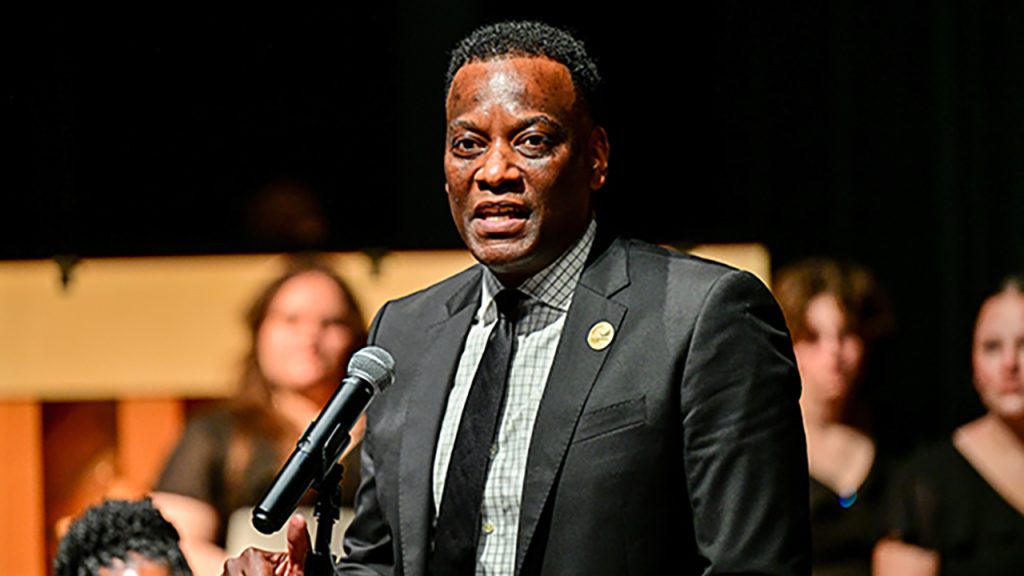
“It is good to be home,” Elder said. “The older I get the more appreciation I have for Troy, the community – it’s my foundation. It is good to see family, classmates, the mayor who is a classmate as well. It is just so good see everybody in such a positive arena. It was very flattering to get this invitation since I haven’t spoken publicly in Troy since graduation in 1990 in Sartain Hall. As I walked across the campus, I was amazed at how Troy University has changed. It is a beautiful campus. The number of degree offerings and the local, state, regional and national impact is exemplary, and Chancellor Hawkins is to be commended. There are a lot of positive things happening in Troy.”
Elder told the gathering that limitations are often placed on leadership and service.
“When I think about leadership, the first thing I know, particularly being in academia, is that leadership is often limited and serving is limited,” he said. “What I mean by that is that we don’t invite everyone to lead. We try to find ways to disqualify leaders and those who really want to serve. We do it in a number of ways – you don’t have a degree, or you have a degree, what major – it’s not the right major, what university – it’s not the right university, by gender, by race/ethnicity. We are seeking people who are familiar or people who are previous leaders.”
Elder said he has always strived for diversity in groups with which he has been involved.
“All of the research projects I have ever worked on, we never assemble a group of researchers that look like us. We don’t duplicate ourselves,” he said. “One of the great things about putting together a team that is varied in its experiences and knowledge is that it strengthens the team. Diversity is absolutely needed. It is a source of excellence. The literature is clear, without diversity it is impossible to achieve excellence.”
Elder said that when it comes to leadership, he is driven by a core group of values and ideas he drew from his parents.
One such core involves what people consistently expect from him.
“When I first went to St. Louis University, a Jesuit university and a Research 1 institution at the time, I became chair of the seventh best department in the country. People told me that I had to come in and set people straight, put my foot down. My core is different. When you must manage others’ expectations and they are incongruent with your on, sociologists tell you that it is what is deemed as emotional labor. It is taxing to be something you are not. That doesn’t work for me. The core value of being consistent and being true to who I am is important to me.”
Another leadership core Elder pointed to dealt with how one treats others.
“My mother always used to say, ‘be careful how you treat people because the same people you see on your way up, you are going to see on your way down,’” Elder said. “I think ethics is still a core for most students, but ‘developed ignorance’ simply says that if you want to make society better and fair, you will view things behind a level of ignorance because you don’t know where you are going to be in the future. You want to make policies and programs that don’t disadvantage anyone because you might need those same policies and programs in the future, yourself. I want to make sure that I’m making decisions that are benefitting everyone even if folks don’t agree with me. I want to make certain that I am creating policies and programs on our campus that benefit all.”
Recalling his difficulty in spelling as a youngster and how his mother helped him overcome those challenges, Elder reminded the audience not to “delegate the hard stuff.”
“My mother went through the words with me. She could have crushed my spirit, but she didn’t. She could have said ‘You’re never going to get’ or ‘you’ll never learn it.’ She knew it was in me, and she knew it was her responsibility to bring it out,” he said. “That is what I try to do daily with people. I don’t shy away from the challenging things. When we must tell a student that it is not working for them or tell a faculty member that their contract is not going to be extended, I do that personally. People can take bad news if you don’t humiliate them in the process. I work with a lot of undergraduate, graduate, professional students and colleagues who some folks said simply could not do it, they don’t need to be here. Working with them, all of them didn’t make but the overwhelming majority did because someone stayed the course with them and believed in them.”
Elder closed his remarks with two final core values he took from his parents – be a good listener and be thankful for what you have.
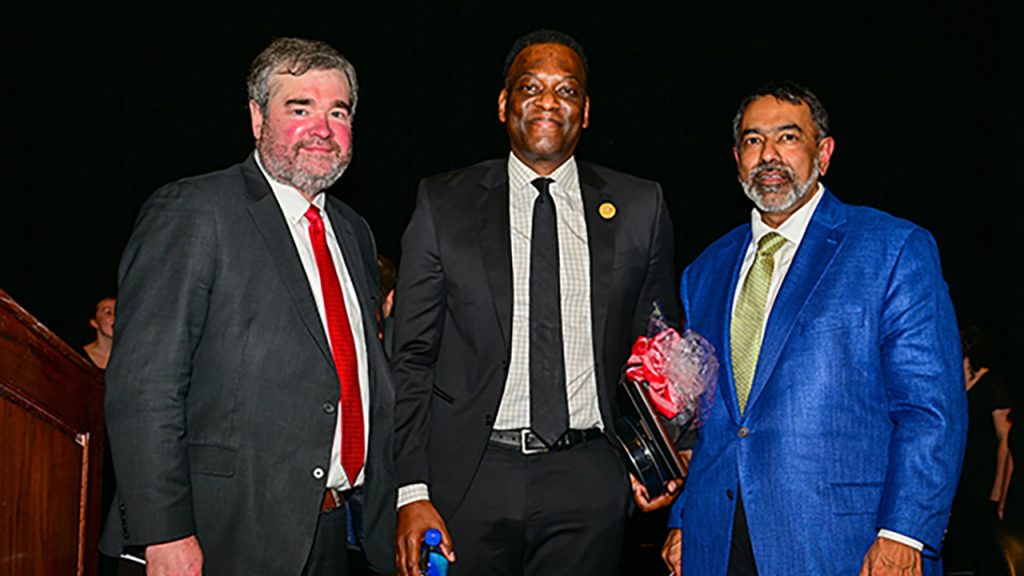
Prior to his remarks, Dr. Elder was presented with two plaques from Troy Mayor Jason Reeves – a “Welcome Home” plaque presented on behalf of the city and a plaque from the Charles Henderson High School Class of 1990 in recognition of his visit and his many accomplishments.