Students in the College of Arts and Sciences had the opportunity to present their research projects last Thursday during the inaugural Trojan Research Week held April 21-25.
Ranging from environmental studies to history, philosophy, biomedical research and more, Student Research Day allowed undergraduate and graduate students to showcase their research and gain first-hand experience presenting their findings.
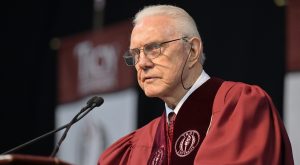
“The College of Arts and Sciences had a successful launch at the inaugural Trojan Research Week,” said Dr. Govind Menon, Dean. “I was highly impressed by the quality of our students’ work. Moving forward, our student scholars will have the opportunity to share their research with fellow Trojans annually. I see this as a part of an academic renaissance at Troy University.”
Matilda Zielger, a senior American history major from Shelby, North Carolina, gave two presentations. The first, titled “Mobile National Cemetery: United States Colored Troops (MNC/USCT),” focused on raising awareness of the military service of African American veterans who are interred at national cemeteries.
“I had the immense privilege of being the 2024-205 Chancellor’s Fellow, and I worked with Dr. Robert Carlson on this project,” she said. “I’m working on about 20 biographies of Black men, many of whom were formerly enslaved, who served in the United States Colored Troops in the Union Army during the Civil War.”
This research was made possible thanks to the Veterans Legacy Grant awarded by the U.S. Department of Veterans Affairs National Cemetery Administration.

Her second presentation, titled “Defeating the Death Penalty: A Refutation of Pro-Death Penalty Arguments,” was a critical examination of the philosophical arguments that support the death penalty.
“I used utilitarianism and Kantianism to defend the cessation of the death penalty in the United States and around the world,” she said. “I developed an interest in this topic in an ethics class, and I think that often there is a false narrative that all families of murder victims are pushing for the death penalty. As the family member of a murder victim, that is not the case for me or most other members of my family.”
Ziegler said Trojan Research Day provided her an outlet to not only discuss her research topics, but to gain first-hand experience presenting her research to an audience.
“I really enjoyed being able to educate others, especially my classmates and instructors in the College of Arts and Sciences, and it was exciting to hear presentations about topics I was not knowledgeable in,” she said. “I do plan on going to graduate school, becoming a professor and pursuing my Ph.D., and having the Chancellor’s Fellowship this year has inspired me, ignited my love for research and helped me decide that this is what I want to do for the rest of my life.”
Emily Hyman, a junior biomedical sciences major from Mobile, Alabama, presented the research she’s conducted alongside Dr. Jacqueline Jones, Chair of the Department of Environmental and Biological Sciences. Her presentation was titled “Investigating the Role of FOXI3 and EMT in Advanced Prostate Cancer,” and her research was funded by a Tri Beta grant.
Epithelial-mesenchymal transition (EMT) is a cellular process where epithelial cells, normally tightly packed and polarized, undergo a dramatic change, becoming more mobile and invasive mesenchymal cells.
“It’s like a shape change,” Hyman explained. “They go from being a stable cell in a tissue to an elongated cell that can move and metastasize. We’re seeing what happens to FOXI3, the transcription factor Dr. Jones’ labfocuses on, if we inhibit EMT. So if we tell the cancer cells, ‘no, you can’t do that,’ how does that change the gene expression.”
She first presented her findings earlier this year at the Association of Southeastern Biologists conference, which also coincided with the Tri Beta District Convention. Hyman said coming back to familiar faces in TROY was a welcome experience.
“It was great to get to share my work with professors and students alike and to also see all of the other research going on at TROY that I’d never heard of before,” she said. “Throughout this process, I really learned a lot about trouble shooting, patience and critical thinking. It really helped me to encounter issues and step back and think, ‘Why did that happen?’ ‘What can I try differently next time?’ The ‘why’ was really important to me. The work allowed me to discover a love of research, but also forged a greater connection to concepts I’ve learned in class.”
Hyman has accepted a 10-week internship at the Basic Biomedical Sciences Institute at the Johns Hopkins University School of Medicine under Dr. Dipali Sharma researching how obesity, racial disparities and the microbiome influence breast cancer.
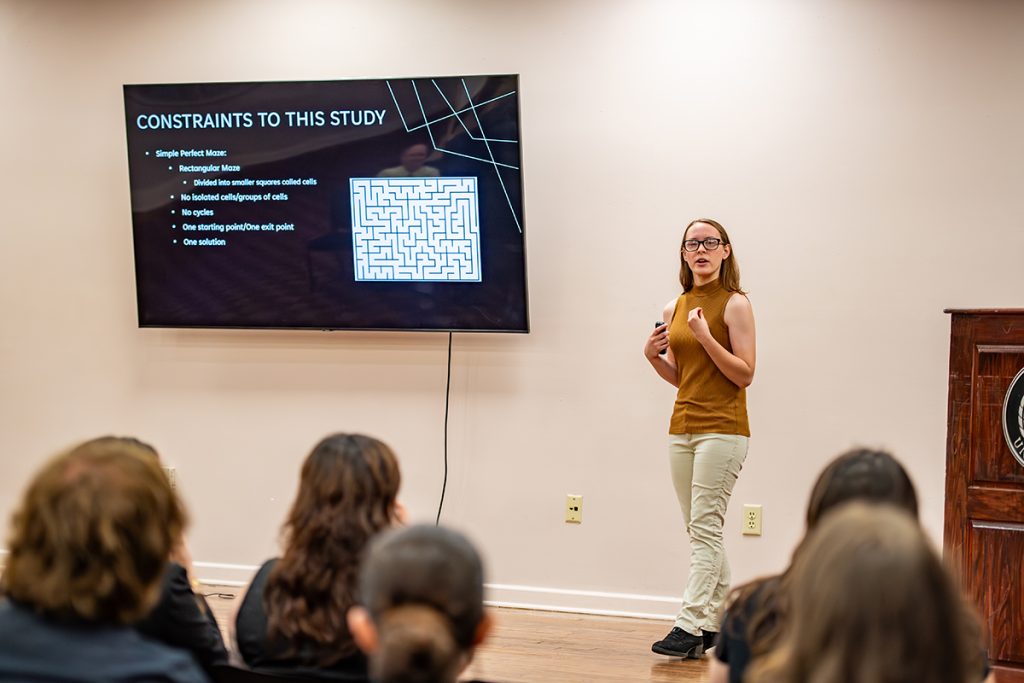
Additional presentations featured Judson Keel, “State Building Counterinsurgency in the War on Terror and Beyond,” and Kassidy Adams, “The Applications of Graph Theory in Modeling Mazes.”
In addition to the presentations, two poster sessions were held featuring additional research projects, including:
- Noah Hallman: Investigating Properties of Fish Gelatin-Based Precursors for Electrospinnability Tests
- Harley Hicks: Gelatin-Based Nanofiber Scaffolds for use as Tissue Engineered Cardiovascular Grafts
- Ved Dharkar: Improved Performance of GaAs Photodetectors Through Thermo-Plasmonic Enhancement
- Sophie Richards: Fish and Crayfish of the Troy University Arboretum
- Mayra Schliemann: Metal-Doped Semiconductor Plasmonic Optoelectronic Switch
- Jackson West: Alumina-based Nanofibrous Ceramic Membrane as a Filtration Platform
- Veronica Lahue: Expansion of an AGN Cosmological Distance Measure
- Elizabeth Alexander: The hydrophilicity of Fish Skin Gelatine nanofibers and their potential for cell growth
- Joshua Bailey and Hailey Williamson: A survey of trees, shrubs, and woody vines of Blue Springs State Park and Forever Wild Tract, Barbour County, Alabama, as a part of a Dendrology course at Troy University
- Madison Lamb-Lott: An Environmentally Safe Method of Crosslinking Gelatin Based Nanofibers for a Tissue Engineered Scaffold
- Elizabeth McMahan: Detection of Pathogens in Tarballs Collected from the Alabama Gulf Coast
- Nautica Morgan: Unlocking PCOS (Polycystic Ovary Syndrome): “Pathophysiological Indicators to Improve Diagnosis”
- Ethan Jones and Fisher Parrish: Talking Turtles
- Joshua Bailey, Tyler Parrish and Hailey Williamson: Herbaceous vascular plants of Blue Springs State Park and Forever Wild Tract, Barbour County, Alabama
- Giulianno Rivero: The Nucleotide Content of the 3’UTR in Human mRNAs
- Caleb Skelly: Pigmentation of Silk in Bombyx mori
- Ryley Dykes: Microbiome composition differences among four species of freshwater mussel found in the Tallapoosa River (Alabama)
A gallery of images can be viewed here.