More than 80 students and 19 teams competed in the Department of Computer Science’s annual Hackathon competition, a 24-hour coding event where students tackle real-world issues.
Students began arriving at Patterson Hall on the Troy Campus at 8 a.m. on Saturday, Nov. 8 for check in followed by an opening ceremony and a description of the projects.
“This really represents what I would like to see this University do on a broader scale in the next few years,” said Dr. Kerry Palmer, Senior Vice Chancellor of Academic Affairs. “We have to be able to show that our graduates can do the actual work, and this is a prime example of that—students coming in, sitting down and doing the type of work they expect to do in the future.”
Intended to focus on current issues in tech, teams had the option to choose between AI-based projects in cybersecurity, web development or language models by creating password strength checkers, automated purchasing computing agents, real-time collaboration boards, writing tutors or research assistants.
Representatives from Air University also offered higher-difficulty, higher-scoring projects in health performance management systems for Android smart devices and AI/ML aided drone detection.
“These kinds of new topics will bring interest to the students, and we’re trying to stay current as much as we can,” said Dr. Byungkwan Jung, Assistant Professor and TROY Hack organizer. “These are going to be hot topics for a while, so we want our students to be able to have skills working with these problems before they get into the industry.”
Mentors from Air University’s Innovation Accelerator (AUiX) and C Spire were available throughout the event to provide support and guide participants through workshops and thought-provoking discussions. The hack ended at 8 a.m. the following morning with the closing ceremony held shortly after 12:30 p.m. after a lengthy deliberation process.

Teams were judged on innovation and creativity; technical excellence; functionality and completeness; impact and usefulness; teamwork and collaboration; and presentation and pitch.
“The teams’ projects were very diverse—some hands on, some theoretical—but they all showed superb skills in creativity and in fast learning using programs they weren’t familiar with,” Jung said. “They really pushed themselves to the limit. They had fun, but they did a lot of hard work. This type of activity is different from the coursework, and we’re able to uncover a lot of hidden talents and skills. This helps students realize their potential.”
Third place was awarded to the team of Mihir Patel, Sarala Bhandari, Megh Patel and Kashyap Vaghani, and second place went to the team of Dong Liang, Jaden Graves, Ty Oldham and Nan Hoang.
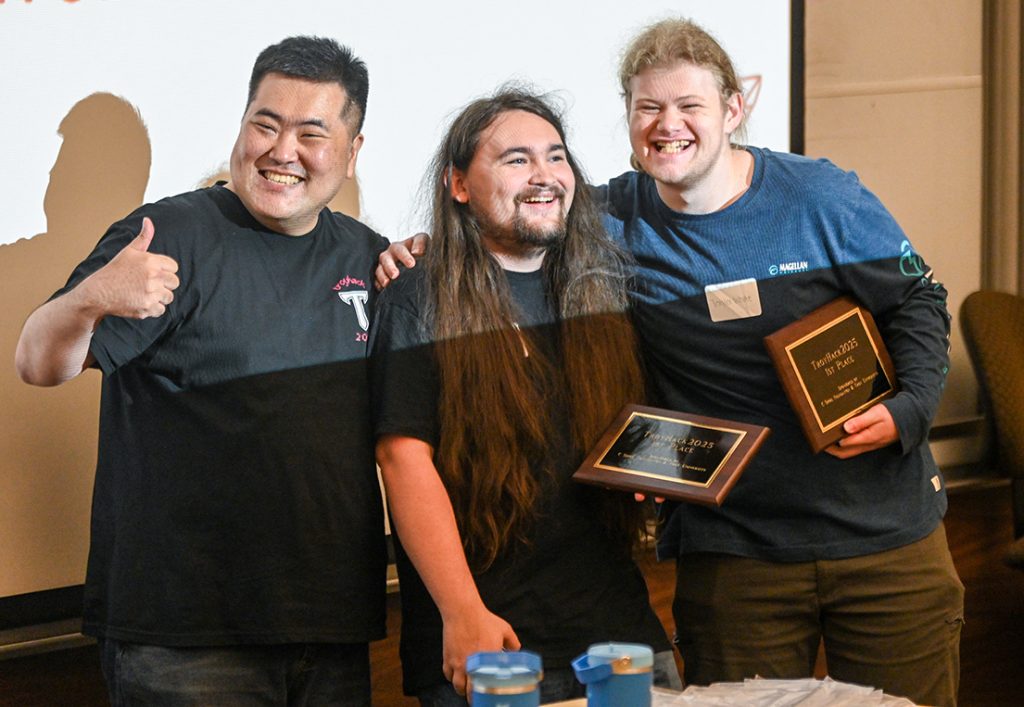
First place was awarded to Charles Wood, Taylor White and Danyael Vera. The team chose to take on AUiX’s drone detection project.
“We tried to identify whether they were decoy drones with lower-power motors or if they are high performance, larger drones that could potentially cause harm to civilians,” Wood said. “This prompt gave us the chance to show our skills. I have a strong math background as a dual major, so we first wrote out all of our equations and functions, and once we had a discussion about how we’d structure our data, process the audio and allocate the allocate memory… we didn’t have a lot of experience with Android app development, so instead we embedded a Python run time into the Android app. That gave us the portability of an Android app and the power and flexibility of a language we understood.”
Wood said the Hackathon was a valuable learning experience that allowed him to work on a high-profile project that has a real-world application. White added that the competition also showed him his knowledge gaps.
“I should definitely expand my programming language in the near future, hopefully before the next time we do this,” White said.
The event was sponsored by the C Spire Foundation, the Department of Computer Science, Marco’s Pizza, Troy Buffet, AUiX and Alfa Insurance.
For more information on the Computer Science Club or TROY Hack, email csclub@troy.edu.
A gallery of images can be viewed here.