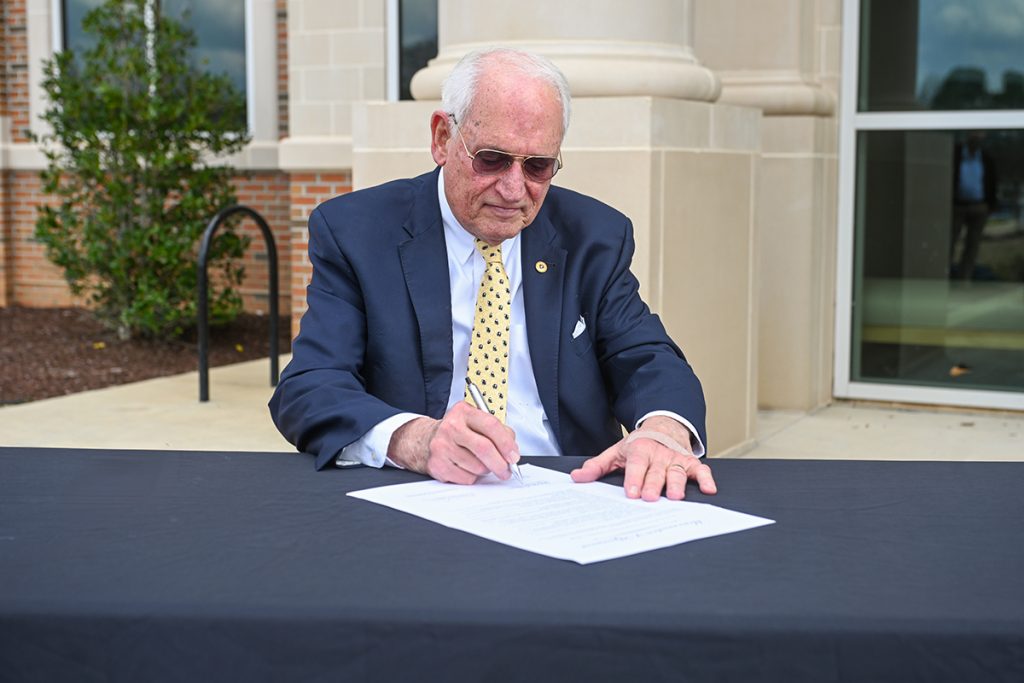
Troy University and Enterprise State Community College have signed an agreement to create a pathway for ESCC students to earn a bachelor’s degree in Electrical and Electronics Engineering (EEE) from TROY.
The partnership ensures that students who successfully complete Enterprise’s Mechatronics coursework can transfer to TROY’s EEE program with guaranteed acceptance, provided they meet outlined academic requirements.
“As I like to remind students, there’s nothing more important in life than relationships—not money, not things, but people,” said Troy University Chancellor Dr. Jack Hawkins, Jr. “I believe the way Enterprise State does business is truly to serve the community, and for an institution to realize its potential, you have to break that ceiling that often restricts your ability to serve. We share a strong partnership with Enterprise State and always have. We’re very proud of that, and very proud of the students they send us.”
Under the agreement, Enterprise students must complete all prerequisite courses before enrolling in upper-level classes at TROY and meet all degree requirements listed in the University’s Undergraduate Catalog. To be admitted, students must have earned at least a 2.0 GPA (“C” average) or higher in all college-level coursework.

Students may transfer up to 64 semester hours from ESCC toward the TROY degree plan in EEE. Credits must align with TROY’s degree plan and cannot duplicate previously earned credits. Students who earn a “C” (2.0 GPA) or higher overall will receive credit toward the EEE degree plan.
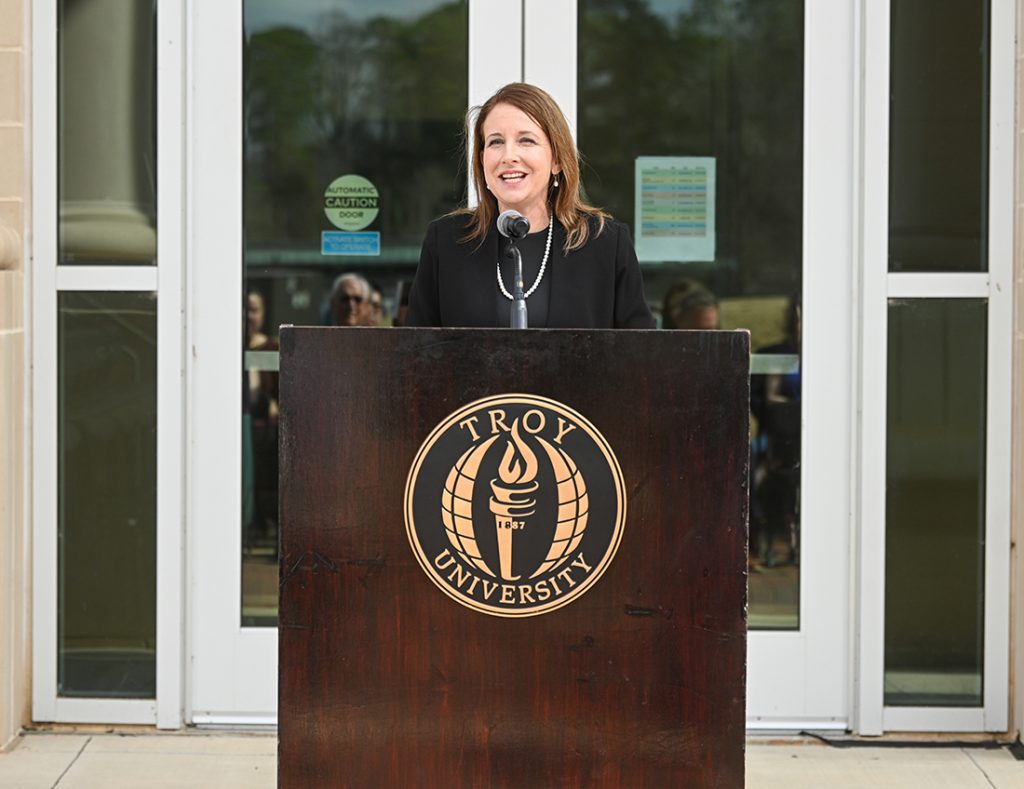
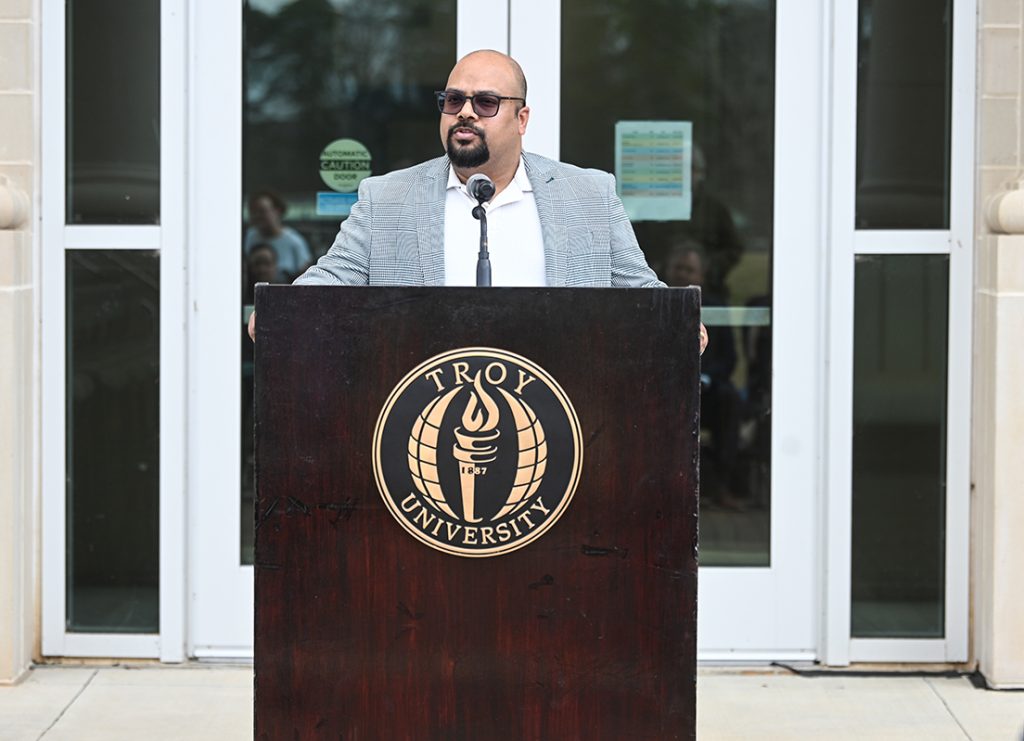
“Today is one of those days where we get to connect people and do meaningful work,” said Dr. Govind Menon, Dean of the College of Science and Engineering. “We have successful students from Enterprise State and outstanding faculty in both programs. We’re excited about this partnership and look forward to our continued relationship.”
The agreement emphasizes collaboration between the two institutions to promote the pathway and assist students during the transfer process. TROY will provide representatives to help with enrollment and advising, while ESCC will coordinate with TROY to share program information and marketing strategies.
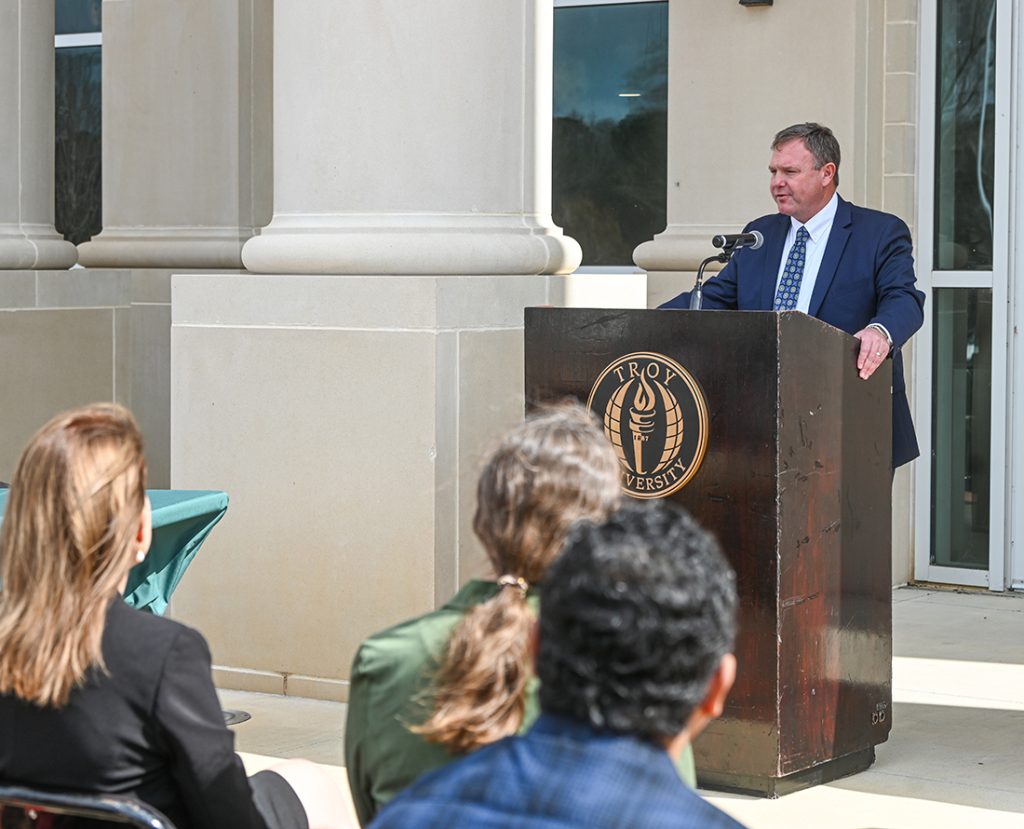
“It’s always good to come home,” said ESCC President Daniel Long, a TROY alum. “This is an exciting opportunity. If we’re going to recruit manufacturing industries in the Wiregrass, this program and our relationship with TROY’s program is only going to strengthen that cause. I think our partnership can be a force in recruiting additional economic development opportunities for the Wiregrass. I’m proud to be here, I’m proud of the work TROY is doing and certainly proud of Dr. Anna Head [Dean of Instruction] and Aubri Hanson.”
Both institutions will review the agreement every two years to ensure it continues to meet the needs of students and the workforce. The partnership will remain in effect as long as both institutions maintain regional accreditation through SACSCOC.
“These types of opportunities are not always afforded to students who go through CTE programs at the community college level, so for TROY to recognize that we can provide valuable students for an engineering-level program is especially important,” said Applied Technologies Division Chair and Mechatronics Instructor Aubri Hanson. “It’s very meaningful to me. Thank you to President Long and Dr. Head, and to Dr. Hawkins and Dr. Raj Vinnakota at TROY for allowing us to have this partnership.”

About the Bachelor of Science in Electronics and Electrical Engineering at TROY
The Bachelor of Science in Electrical and Electronics Engineering was approved by the Alabama Commission on Higher Education on March 14, 2025 and provides a cutting-edge curriculum that integrates theory, hands-on learning and industry-driven innovation.
With a future-focused curriculum and the goal of producing industry-ready graduates, the program boasts small class sizes and personalized learning, advanced specializations, innovative technologies and hands-on learning opportunities at each stage.
“This program marks a significant milestone in TROY’s commitment to advancing engineering education,” said Dr. Raj Vinnakota, interim director of the Center for Materials and Manufacturing Sciences, EEE assistant professor and the program coordinator. “By integrating cutting-edge coursework with hands-on experience, we are preparing students to become innovators and problem-solvers in a rapidly evolving technological landscape.”
Based on data from the Alabama Department of Labor’s Labor Market Information Division, electrical engineers are projected to have an average of 225 annual job openings and offer a median annual salary of $103,652. According to the Bureau of Labor Statistics, Engineering Occupations (National Employment Matrix Code 17-2000) are predicted to experience a 5.1 percent rise between 2021-2031.
Key sectors and career paths include the semiconductor industry; robotics and automation; telecommunications and wireless technology; power and renewable energy; embedded systems; photonics and optoelectronics; and aerospace and defense.
“As industries increasingly rely on advancements in semiconductors, telecommunications, automation and renewable energy, this program will equip students with the expertise needed to meet workforce demands,” Vinnakota said. “It fosters university-industry collaborations that drive innovation and economic growth.”