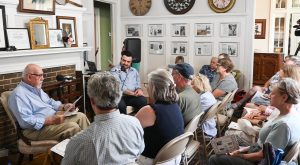
At a time when much of physics research is driven by large-scale experimental collaborations, Troy University’s Center for Relativity and Cosmology is building something rare: a focused, rigorous hub dedicated to the study of relativity, cosmology and mathematical physics.
With four faculty members working exclusively in general relativity and related fields, the Center has positioned itself as one of few institutions in the country with a concentrated effort in theoretical gravitational physics—an area often considered one of the most mathematically demanding.
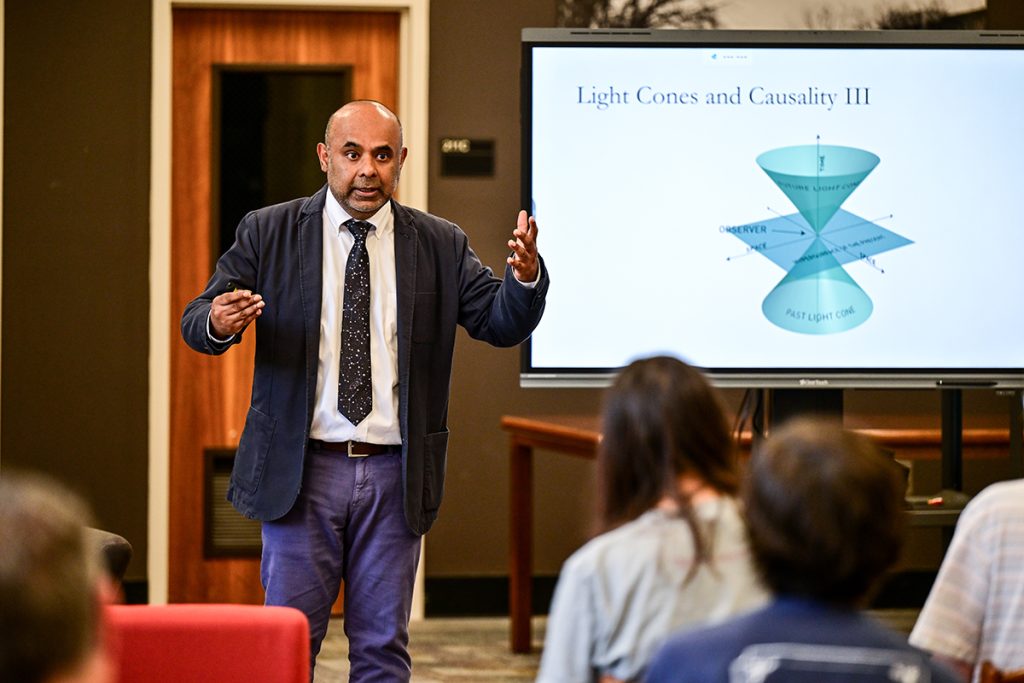
“We work very hard,” said Dr. Govind Menon, Dean of the College of Science and Engineering. “This is not meant to be a huge program, but it’s meant to be a very premium, prestigious program.”
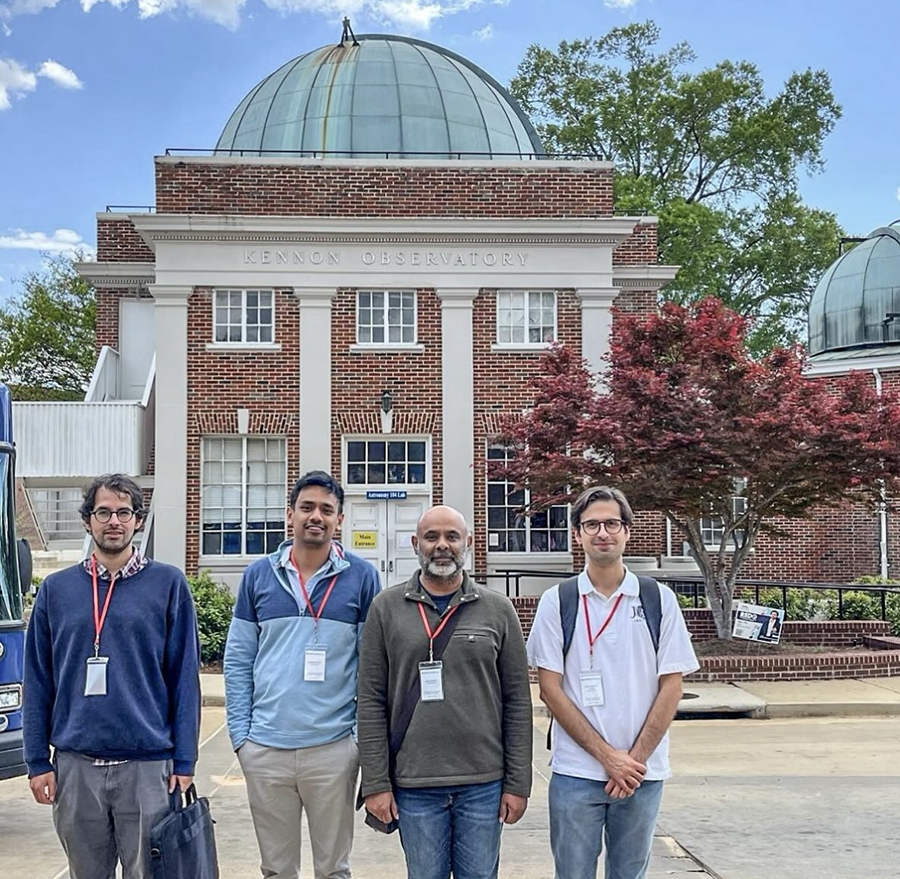
Menon and Dr. Rakshak Adhikari, Assistant Professor, both study different variations of black hole astrophysics— Menon’s research focuses more on the mathematical side, while Adhikari studies electromagnetic fields outside rotating black holes. Adhikari’s research also extends into cosmology, where he uses supercomputer simulations to study dark matter and the formation of cosmic structures such as galaxies and galaxy clusters.
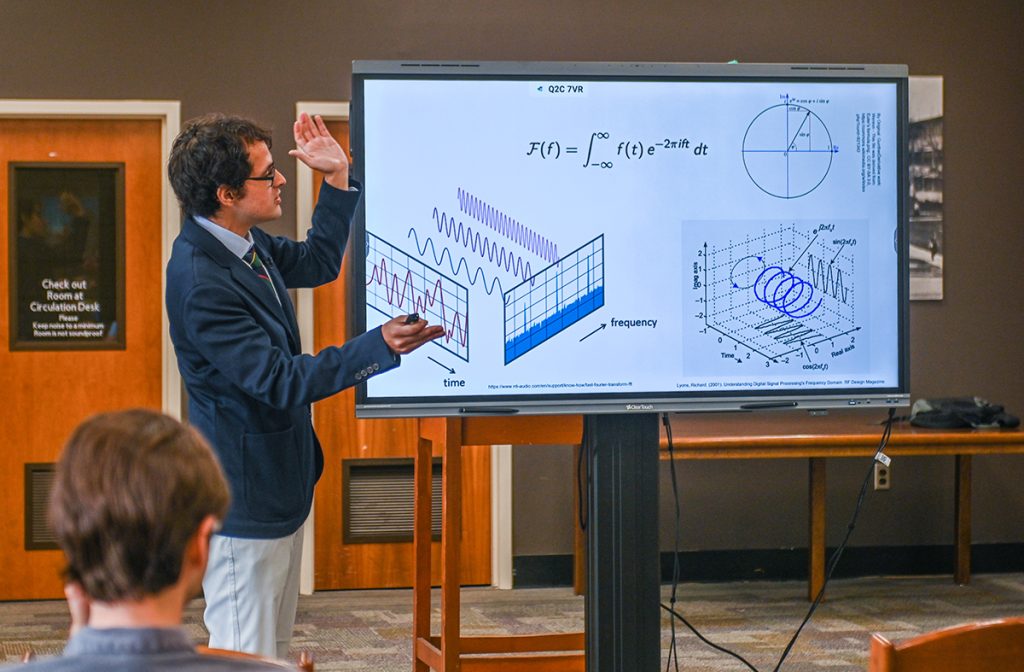
Assistant Professors Dr. Yafet Sanchez and Dr. Bruno Costa study quantum fields in curved spacetime. Sanchez’s research centers around waves, and Costa’s research “focuses on an intersection between quantum phenomena and gravitational phenomena,” he said.
“TROY’s Center for Relativity and Cosmology is unique because there aren’t many centers studying theoretical gravity the way we are,” Costa said. “That we have a group of people with the same interests is priceless. The way the Center is growing, and the way the University is growing, is extremely positive.”
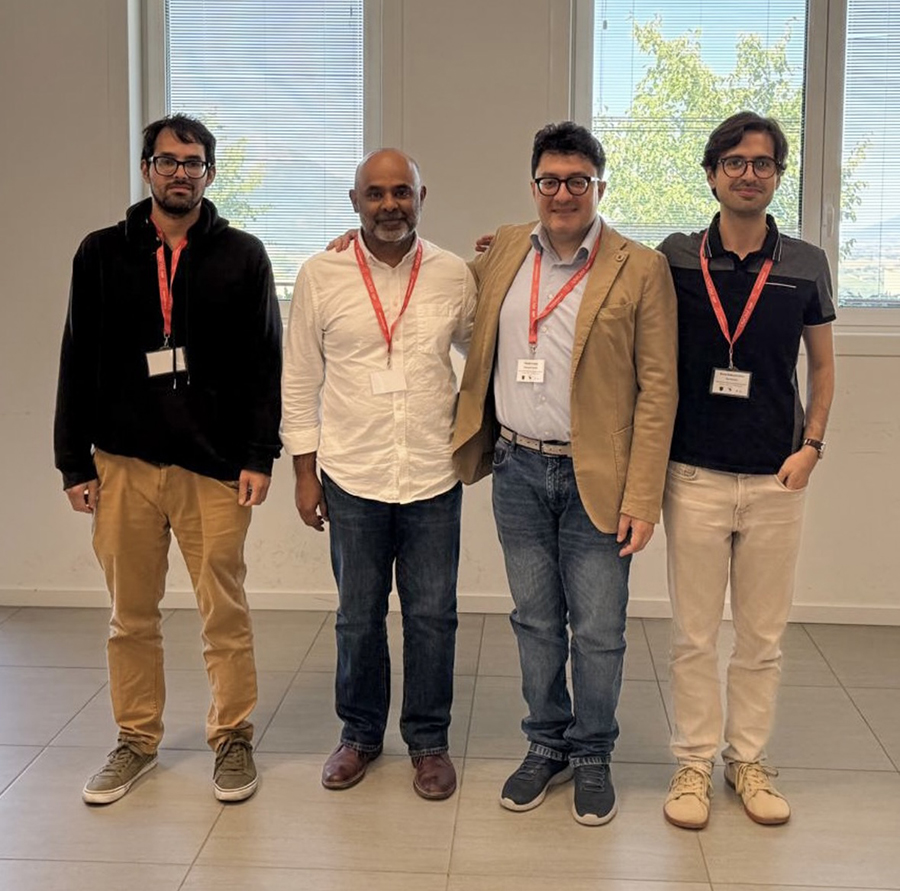
While the faculty often collaborate with each other on research projects, they have also established collaborations with colleagues at the University of Kansas, the University of Florida and MIT, and are building a new collaboration with the University of Camerino in Italy.
“The Center has been a great way to connect with other professors. It’s easy to end up in your own research bubble—and social bubble—but the Center creates a space where you can share ideas, start collaborations and really engage with the broader academic community,” Sanchez said. “The Center is focused on building a strong pipeline that connects undergraduates to master’s students and beyond. That creates a robust environment for research, particularly in gravity.”
Designed specifically for students intent on pursuing advanced study in relativity and cosmology, the Center for Relativity and Cosmology and the Department of Mathematics and Statistics recently launched a concentration in Mathematical Physics within the Master of Science in Applied Mathematical Sciences program.
“This is not an easy program,” Menon said. “Curriculum-wise, it’s about as rigorous as it gets. Students need to come in with a very strong background in mathematics, ideally with research experience in relativity, and be prepared to work very hard. The courses we offer here are the kind students at many institutions might only encounter occasionally, if at all. Here, this is our central focus. It’s a very rigorous, hands-on program.”
The Center expects to welcome approximately six graduate students and additional Ph.D. students this Fall, and faculty members are already working closely with incoming students, helping align undergraduate capstone projects with future master’s thesis research.
Beyond faculty research, the Center plays a central role in strengthening TROY’s overall academic standing. It hosts public seminars, invites guest researchers and this April will host the 12th Gulf Coast Gravity Meeting, a regional conference that brings together researchers working in all areas of gravitational physics: classical and quantum, theoretical and experimental.
In March, the Center will host Fulbright scholar Dr. Jiří Minarčík, a geometer and postdoc at Carnegie Mellonfrom the Czech Republic. Though not directly focused on gravitational physics, his expertise connects to the broader mathematical structures underpinning relativity, reinforcing the Center’s commitment to interdisciplinary engagement.
“Dr. Minarčík’s work is adjacent to our core research areas, which is part of the point of research: understanding the broader mathematical ideas connected to our field,” Adhikari said. “Having four researchers in general relativity theory in one place is rare and creates an unusually strong environment for collaboration.Because general relativity theory is rarely part of the standard physics curriculum and requires sophisticated mathematics, students here have a rare opportunity for focused training and close faculty mentorship.
“We’re looking forward to hosting Dr. Minarčík’ and learning more about how his research relates to ours.”
In April, Ramesh Radhakrishnan, a Ph.D. student at Baylor University, will give a guest lecture on his work on rotating wormholes.
For more information about the Center for Relativity and Cosmology, visit http://troy.edu/crc.