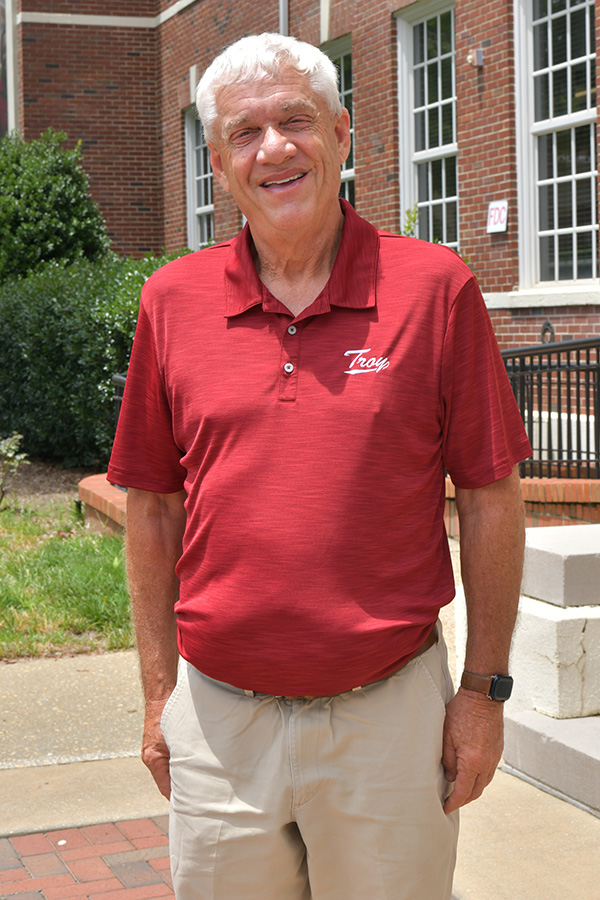
For more than three decades, Dr. Clint W. Relyea has expanded global opportunities for university students across continents and cultures. Now, a leading international journal has formally documented that impact.
New research published in the Journal of Management Education highlights the career and international influence of Relyea, Associate Professor of Management in the Sorrell College of Business.
The peer-reviewed article, authored by Dr. Brandon A. Griffin and Dr. G. Paul Willis, offers a detailed examination of his work developing international programs and preparing students for careers in a global economy. The interview was conducted in Hanoi, Vietnam, while Dr. Griffin and Dr. Relyea were teaching abroad, underscoring the international scope of his career.
“I think this research really does two things. First, we get real-world stories and evidence of successes and failures Clint has had during his career, which is very valuable. The in-depth interview allows us to discuss important concerns for faculty and administrators using a unique methodology. Second, this article honors him by showing that he has had a massive impact on his universities and students,” said Griffin.
The article organizes Relyea’s work around four central themes drawn from the global citizenship framework. First, it emphasizes the intentional development and assessment of intercultural competence as a core outcome of management education. Second, it highlights the importance of fostering transformative worldview growth through sustained and layered international experiences. Third, it stresses the need to design meaningful learning opportunities that move beyond educational tourism and incorporate applied, service-oriented engagement. Finally, it underscores that successful study abroad initiatives require both committed program champions and strong administrative support to ensure long-term sustainability.
The research shows how those principles take shape in practice. Under Relyea’s leadership, students have participated in cultural immersion experiences in New York City, visited international corporations and port operations in Mobile, engaged with business leaders in Atlanta, and traveled abroad to countries such as Mexico. These experiences move students beyond classroom theory and into real-world business environments where they interact with executives, explore financial districts, and engage multinational firms firsthand.
Many students return with greater confidence, adaptability, and sharper professional focus. For some, international travel becomes a turning point that reshapes career ambitions and expands their understanding of opportunity beyond their home state or even their home country. Relyea’s former students now work in leadership roles in business both in the United States and abroad.
The research also addresses a critical long-term challenge facing many academic initiatives. As Relyea approaches the later stage of his career, he reflects on the future of the programs he built. A natural question emerges: when Relyea ultimately retires, what will happen to the program he created? Students often jokingly ask him to promise he will stay until they graduate, but the broader issue is serious. Programs centered on one visionary leader can lose momentum if they are not intentionally sustained.
Drawing on the concept of “routinization” from organizational theory, the article emphasizes the importance of embedding successful initiatives into curriculum, policy, funding structures, and succession planning so they endure beyond individual leadership.
At Troy University, many of those structures are already in place. University leadership has prioritized global competitiveness as part of the institution’s mission. Chancellor Jack Hawkins Jr. has supported initiatives that reduce financial barriers to study abroad, including the Chancellor’s Award for Global Competitiveness, which provides eligible students with a $1,250 annual award for international experiences. Within the Sorrell College of Business, Dean Judson Edwards helped embed international engagement into the College’s strategic direction. By integrating global learning outcomes into curriculum and securing consistent resources, Troy has positioned international education as a lasting institutional commitment rather than a personality-driven initiative.
The article preserves the story of Relyea’s contributions while offering guidance to educators worldwide seeking to strengthen global business education.
“It is truly an honor to work alongside a colleague with the depth and breadth of experience that Dr. Relyea brings to our college. His dedication to his students is extraordinary. I’ve watched students grow into globally minded professionals through the program he leads. Some might never have pursued study abroad or international internships without his encouragement and mentorship. He is deeply passionate about his work and generous with his time and guidance,” said Willis.
As global collaboration continues to shape modern business, the research reinforces the importance of preparing students to lead across cultures. Through decades of dedication and the past eight years at TROY, Relyea has helped extend Troy University’s influence far beyond Alabama and into the global business community. Along the way, he has encouraged generations of students to “open their eyes, open their minds, open their hearts, and open their hands.”
The research can be found at https://doi.org/10.1177/10525629261423569 or open access: https://papers.ssrn.com/sol3/papers.cfm?abstract_id=6149988.


