“Dothan is the Boiled Peanut Capital of the World”
In Summer 2022, Dale Cox (a great Troy supporter and owner of Two Egg Television) alerted the Wiregrass Archives to an opportunity to secure a historical marker to memorialize the links between Dothan and boiled peanuts.
The William G. Pomeroy Foundation’s “Hungry for History” program “celebrates America’s food history by telling the stories of local and regional food specialties across the United States” by funding such markers. The Pomeroy Foundation was founded in Syracuse, New York, in 2005 with an unusual pair of missions: to support life-saving treatments for blood cancer patients and to preserve community history. It has assisted thousands of patients and has funded 2175 markers (as of August 30, 2023) in its fifteen programs. Its “Legends and Lore” and “Hungry for History” programs are available nationwide.

To qualify for a marker, a dish must have two or more ingredients, be identified with a locale before 1970, and still be eaten today.
Dothan was recognized as not only as the Peanut Capital of the World but also as the Boiled Peanut Capital of the World by the early 1950s
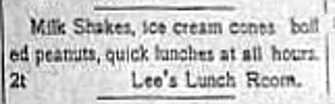
The first documentation of this link between Dothan and boiled peanuts came in an August 31, 1907, advertisement in the Dothan Eagle for Lee’s Lunchroom, serving “quick lunch, ice cream, milk shakes, [and] boiled peanuts.”
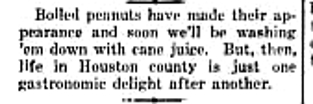
A July 12, 1917, Eagle editorial page notice quipped that “boiled peanuts have made their appearance and soon we’ll be washing ’em down with cane juice. But then, life in Houston County is just one gastronomic delight after another.”
Similarly tongue in cheek, the Eagle claimed more than a decade later that “Dothan is the boiled peanut capital of the world,” though snackers might have considered that a problem because “one never knows when [they’ve] had enough until it’s too late.” (Dothan Eagle, August 1, 1929.)
Dothan cemented its claim as the boiled peanut capital of the world in a July 31, 1936 Eagle editorial – “Dothan consumes more boiled peanuts than any other community in the United States, and therefore on earth. . . . strangely enough, boiled peanuts . . . are disliked by citizens outside those in Southeast Alabama and perhaps West Florida.”
Then in 1938, the paper lamented, “we citizens of the Wiregrass sympathize with one another because the boiled peanut season is drawing to a close. . . . a calamity with which Northern centers as Montgomery, Tuscaloosa . . . and Boston, MA wouldn’t . . . understand.” (Dothan Eagle, September 22, 1938)
The Tuscaloosa News soon conceded Dothan’s pride of place and food. “We,” wrote the News editor on October 4, “neither know nor understand . . . and we don’t care . . . the Wiregrass can have its boiled peanut season, and keep it to itself!”
Idle during World War 2, the boiled peanut industry resumed production soon thereafter. Throngs of boys, both White and Black, hawked bags of boiled peanuts in downtown Dothan during the summer, some earning as much as $200 in 1948. (Based on CPI, that’s worth $2539 in 2023, see www.measuringworth.com)
One boiler reported that while they sold well in Dothan, he could not sell boiled peanuts in Atlanta or Birmingham, and even other Wiregrass towns “will not compare with the demand in Dothan.” (Dothan Eagle, September 30, 1947, October 19, 1948)
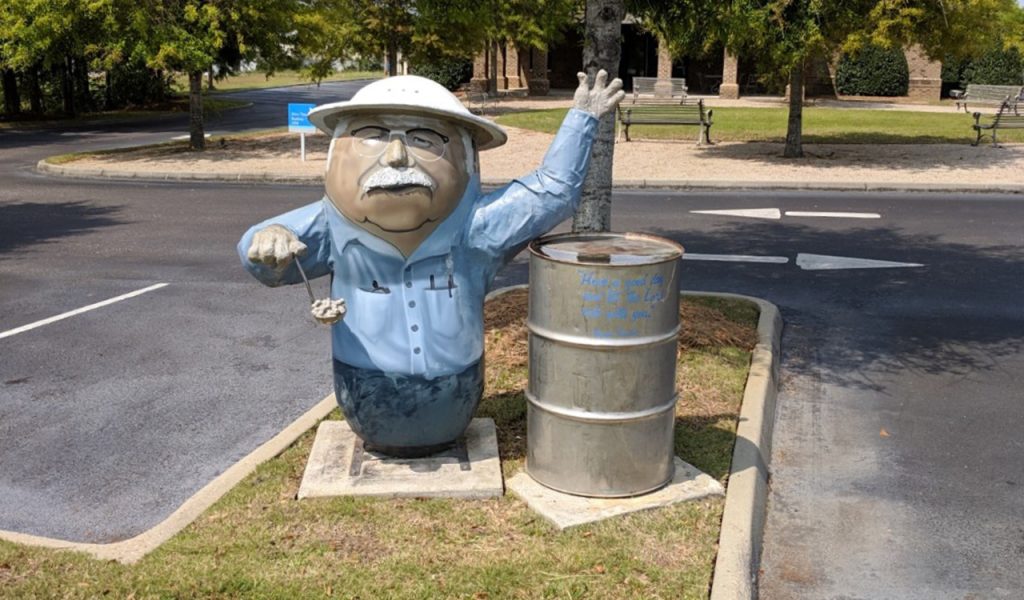
<insert image “Trawick Peanut Man.jpg”> Caption: The Peanut Man Commemorative, W. Main St. at RCC, Dothan.
Boiled peanuts are still readily available in season all over Dothan and the Wiregrass, as evidenced by marquees outside roadside stands along most area highways, as well as the commemorative peanut to Mr. Byron “Cotton” Trawick and his boiled peanut stand at the corner of Ross Clark Circle and W. Main Street. In 2018, AL.com reported that McNeill Farms near Dothan sold between 7000 and 10,000 pounds of boiled peanuts per week in the Spring season.
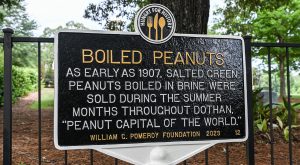
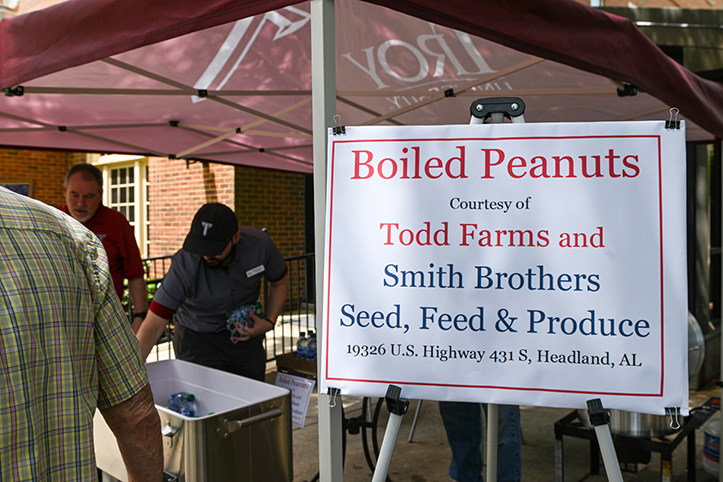
We unveiled the Boiled Peanut marker on May 17, 2023, near the east entrance to Adams Hall on the Dothan Campus. Thanks go to Rachel Conrad Cox, co-applicant on the grant, the Dothan Campus Physical Plant Office and crew who installed the marker with dispatch, Todd Farms and Smith Brothers Feed and Seed of Headland for boiling peanuts on site, and Vice Chancellor Don Jeffrey for supporting this project.