Dothan native Johnny Mack Brown is memorialized by a mural and historical marker on Dothan’s S. St. Andrews Street as well as by a Hollywood Walk of Fame star, but he is not well-remembered today. His career in the limelight as a football legend and movie star spanned from the 1920s into the 1960s.
Born in 1904, Brown played Dothan High School baseball, basketball, and football, earning his nickname “The Dothan Antelope” for his downfield speed. He even had a bit of thespian in him, appearing in a few readings and products of the DHS Shakespearean Club and in a 1924 Writers’ Club of Dothan production of Booth Tarkington’s “Clarence,” a four-act comedy.

Brown graduated from DHS in 1922 and arrived at the University of Alabama on his 18th birthday, but he struggled to make the freshman squad. Through hard work playing both offense and defense, he became a star on the 1924 and 1925 squads.
The January 1, 1926 Rose Bowl cemented his fame. Bama, the second choice to play the favored Washington Huskies after Dartmouth demurred, suffered a lackluster first half. Down 12-0, the future Crimson Tide made a freak touchdown that changed the momentum of the game. Halfback Johnny Mack Brown then caught two long passes for touchdowns and made the game-saving tackle, leading Bama to blow the point spread, 20-19.
Oddly, Johnny Mack left college without graduating. At 21, he was unsure what to do in life. Having majored in business, and after a month’s training in Birmingham, he returned to Dothan to a hero’s welcome and a potential career selling insurance for Aetna. Unsettled, he took a job as a coach for the Bama freshman team for the Fall of 1926 (while he still sold insurance), moved to Tuscaloosa, and married his college sweetheart, Connie Foster, daughter of Jennie and Henry Foster, Tuscaloosa County circuit judge.
Johnny Mack’s movie career didn’t begin with his Rose Bowl victory. In 1924, the movie Men of Steel filmed in Birmingham and, after watching an Alabama football game, character actor George Fawcett encouraged Brown to screen test. He put that off, but when he accompanied the Bama football team to its second Rose Bowl appearance in as many years, accepted Fawcett’s invitation. In early 1927, MGM studios signed him to a five-year contract and by April he had his first (uncredited) role in the sports movie, Slide, Kelly, Slide.
Brown made two dozen movies under MGM contract playing opposite many well-known leading ladies: Marion Davies in 1927 (his first leading role), and Greta Garbo, Madge Bellamy, Joan Crawford, and Norma Shearer in 1928. He made his first talkie, Jazz Heaven, in 1929, and in 1930 made his first western, Billy the Kid, with legendary director King Vidor. The film’s technical advisor William S. Hart even loaned Brown one of William Bonney’s real pistols to use in the title role.

After a career slump from 1935 to 1942 (during which he make 50 low-budget films), he and Monogram Pictures found each other. Brown’s athleticism, looks, and slight southern accent made him popular in the emerging Western serials genre. From 1943 to 1952 Brown made 68 films, his star rising with the Saturday matinees. In addition to dozens of films, he recorded the Under Western Skies radio serial (1939-1940) and had a line of popular Dell comic books (1950-1959).
In October 1950, Brown returned to Dothan as the Grand Marshall of the National Peanut Festival Parade. On horseback, “a dashing figure in white Western regalia complete with tinkling spurs and holstered six-gun,” he was prominent before a crowd estimated by the Dothan Eagle at 70,000.
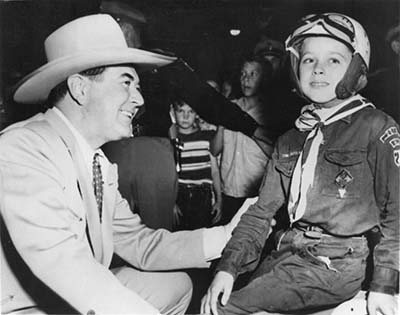
Three years later, Brown returned as the star attraction of the Peanut Parade once again. Finishing a film in Hollywood on October 21, he arrived at the Dothan airport on October 22. Two hours later, he presented trophies at the Cub Scout Soap Box Derby, and four hours after that attended a DHS Class of 1922 reunion at the Houston Hotel. The following day he presented awards at the Peanut Festival beauty pageant at Wiregrass Stadium, and on October 24 rode with twenty-five bands and fifty floats in the parade.

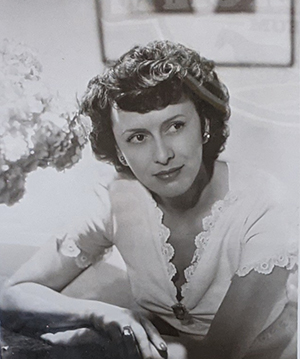
Johnny Mack and wife Connie had four children – Jane, Lachlan (Locky), Cynthia, and Sally. The latter three attended the first Johnny Mack Brown Film Festival in Dothan in 2005. In an interview, they spoke of family life, particularly their childhood memories of events like Christmas, visits by celebrities, neighborhood parties, and music lessons. They also spoke of life after Monogram Pictures closed in 1952 with the effective end of Western serials. Brown played occasional roles on TV and films until his last, regretted role in Paramount’s Apache Uprising in 1966. He worked after 1961 as the affable host and assistant manager of the Tail of the Cock restaurant where he remained a draw for years.
Connie Brown worked in real estate from 1958 until 1982 as the first woman employed as an agent by the Tishman Real Estate Company. She sold homes in Beverly Hills that she knew intimately, having visited so many and knowing their histories. She inspired Jane and Cynthia to careers in real estate, too (Locky sold insurance and Sally taught English in Norway).
Besides his Dothan mural, historical marker, and his Hollywood Walk of Fame star, Johnny Mack received other honors: College Football Hall of Fame (1957), Alabama Sports Hall of Fame (inaugural class with Bear Bryant and Shug Jordan, 1969), Rose Bowl Hall of Fame (2000), the World Cowboy Gunspinning Hall of Fame (2003), the Golden Boot Award (In Memoriam, 2004), and the Alabama Stage and Screen Hall of Fame (2004).
Johnny Mack Brown died at age 70 in 1974 and is interred in Glendale, CA, in a vault shared with his oldest child Jane (d. 1997). Connie Brown died in 1986 and is buried nearby.
The 2005 interview with Johnny Mack’s and Connie’s children, Locky, Cynthia, and Sally, is available at https://www.troy.edu/about-us/dothan-campus/wiregrass-archives/inventories/054.html.
For Further Reading:
Phillip Beidler, “Johnny Mack Brown,” Encyclopedia of Alabama, published September 25, 2008, https://encyclopediaofalabama.org/article/johnny-mack-brown/.
Phillip Beidler, “The Story of Johnny Mack Brown,” Alabama Heritage 38 (Fall 1995): 14-25.
Bobby J. Copeland, Johnny Mack Brown: Up Close and Personal (Madison, NC: Empire Pub, 2005).
Tommy Ford, “Well, He Had to Make a Living Somehow . . .” Tales of Tradition (blog), 2021, https://tommyfordrealestate.com/trails-of-traditions/well-he-had-to-make-a-living-somehow/.
“Johnny Mack Brown,” Wikipedia, https://en.wikipedia.org/wiki/Johnny_Mack_Brown.
Mario DeMarco, “The All-American Cowboy” : Johnny Mack Brown (N.p.: Mario DeMarco, 1982).
John A. Rutherford, From Pigskin to Saddle Leather: The Films of Johnny Mack Brown (Waynesville, NC: World of Yesterday, 1996).
A. J. Wright, Various titles, Alabama Yesterdays: Random Wanderings Through Alabama History (blog), various dates, https://alabamayesterdays.blogspot.com/search?q=Johnny+Mack+Brown.
A 1953 video clip of Johnny Mack Brown and his horse.