Troy University’s new degree program, the Bachelor of Science in Electrical and Electronics Engineering (BSEEE), provides a cutting-edge curriculum that integrates theory, hands-on learning and industry-driven innovation.
Approved by the Alabama Commission on Higher Education on March 14, the program is designed to equip students with the skills and expertise needed to excel in electronics, semiconductors, automation, telecommunications, optoelectronics and emerging electronic technologies.
With a future-focused curriculum and the goal of producing industry-ready graduates, the program boasts small class sizes and personalized learning, advanced specializations, innovative technologies and hands-on learning opportunities at each stage.
“This program marks a significant milestone in TROY’s commitment to advancing engineering education,” said Dr. Raj Vinnakota, Program Coordinator. “By integrating cutting-edge coursework with hands-on experience, we are preparing students to become innovators and problem-solvers in a rapidly evolving technological landscape.”
The degree is designed to meet specialized accreditation requirements in the field of engineering and will provide students with the opportunity to pursue internships and gain practical experience through two capstone courses. The University plans to develop five new courses for the program, which will replace existing Electronics Engineering Technology courses.
The focus on experiential learning will help bridge the gap between theoretical knowledge and practical application, making graduates more workforce ready, Vinnakota said.
Based on data from the Alabama Department of Labor’s Labor Market Information Division, electrical engineers are projected to have an average of 225 annual job openings and offer a median annual salary of $103,652. According to the Bureau of Labor Statistics, Engineering Occupations (National Employment Matrix Code 17-2000) are predicted to experience a 5.1 percent rise between 2021-2031.
Key sectors and career paths include the semiconductor industry; robotics and automation; telecommunications and wireless technology; power and renewable energy; embedded systems; photonics and optoelectronics; and aerospace and defense.
“As industries increasingly rely on advancements in semiconductors, telecommunications, automation and renewable energy, this program will equip students with the expertise needed to meet workforce demands,” Vinnakota said. “It fosters university-industry collaborations that drive innovation and economic growth.”
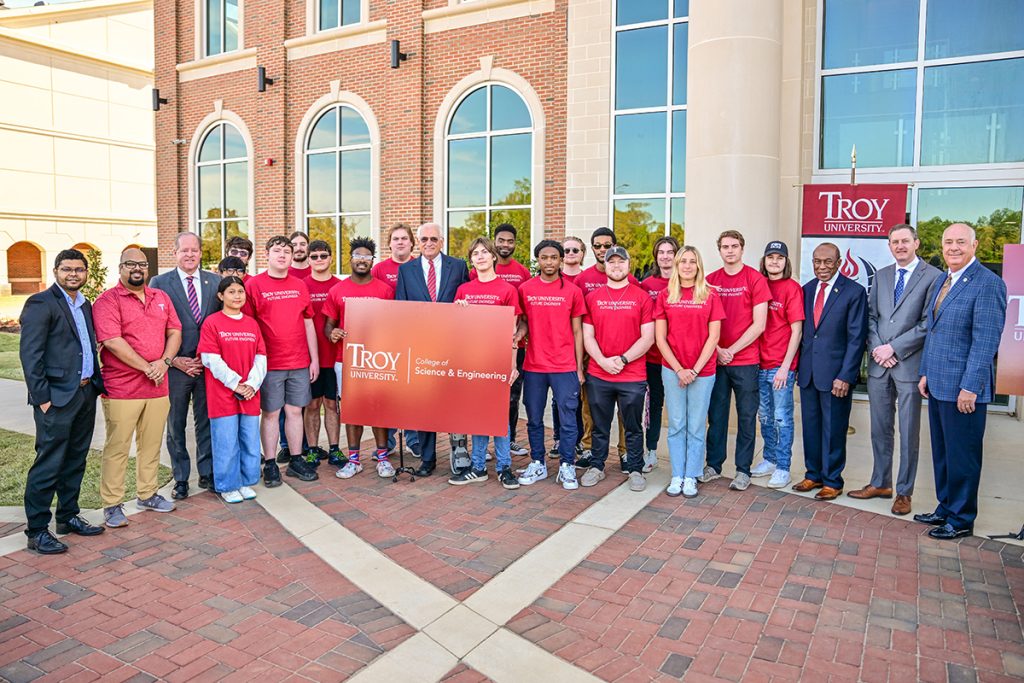
On March 26, the University advanced its commitment to research and innovation with the announcement of the new College of Science and Engineering following the approval of the BSEEE program. The College of Science and Engineering will replace the current College of Arts and Sciences beginning this fall.
Dr. Govind Menon, Dean of the soon-to-be College of Science and Engineering, said the program not only prepares students to excel in the workforce, but also supports TROY’s mission to achieve R-2 research institution status.
“This program not only equips students with the skills needed to thrive in today’s competitive workforce, but also aligns with TROY’s broader academic and research objectives,” Menon said. “By fostering innovation and supporting advanced research, we are preparing students to lead in emerging technological fields, driving economic growth and contributing to the development of cutting-edge solutions that address global challenges.”
The program is welcoming students for Fall 2025. More information about the BSEEE degree is available online.