Rarely seen photos of Rosa Parks taken at the conclusion of the Selma to Montgomery Voting Rights March in 1965 by famed photographer Matt Herron have a new home – Troy University’s Rosa Parks Museum.
Herron, known for his photography of landmark events in the Civil Rights Movement, took the photos of Mrs. Parks at the Alabama State Capitol following the march’s conclusion but had never shared the photos.
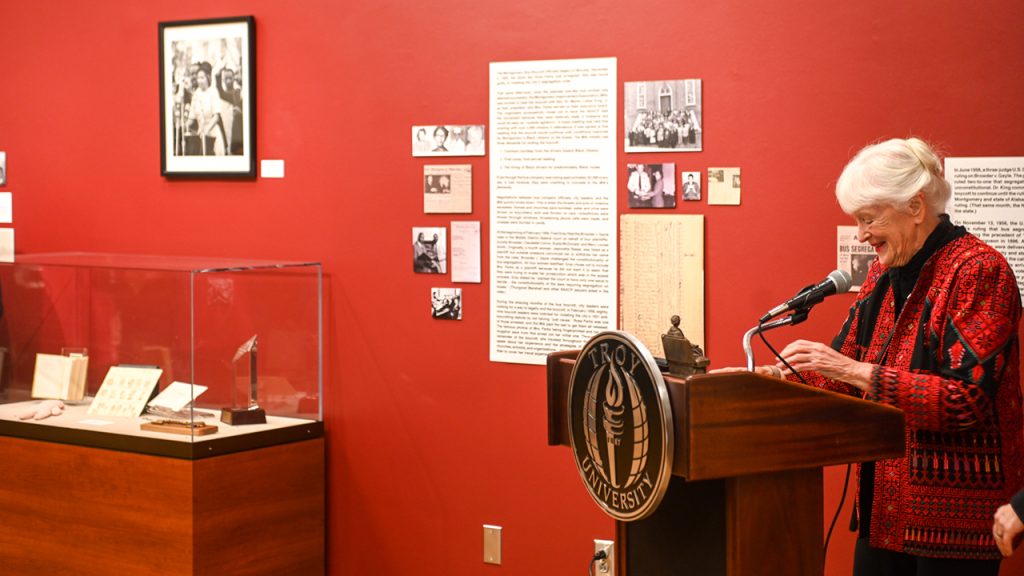
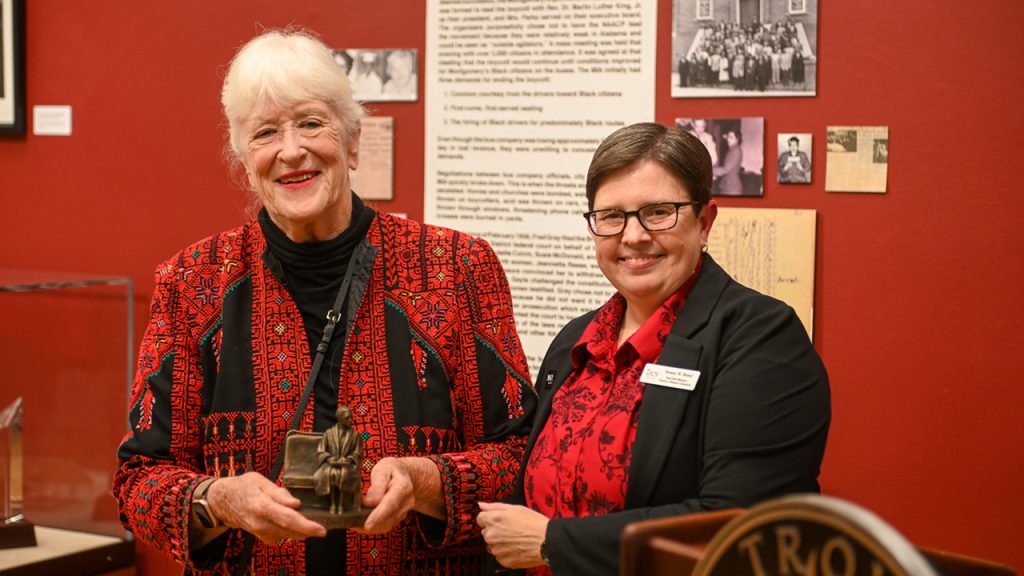
During a reception marking the Rosa Parks Museum’s new exhibit “Rosa Parks: A Life of Being Rebellious” held on Dec. 4, Herron’s widow, Jeannine, donated the photos to the museum. Copies of the photos will also be presented to family members of Mrs. Parks later this year.

During the reception, Mrs. Herron said that her late husband would be extremely pleased and proud that his photos would be displayed at a museum honoring Mrs. Parks’ legacy.
“I just want to say that my husband Matt would be very pleased with this event and with your acceptance of his photographs,” she said. “He was a storyteller, and he loved to tell the story of real people. That is what we have been celebrating this week.”
Herron, who passed away in 2020 at the age of 89, began working as a photojournalist in 1962, and his pictures appeared in virtually every major picture magazine in the world. Based in Mississippi in the early 1960s, Herron covered the Civil Rights Movement for Life, Look, Time, Newsweek and the Saturday Evening post, as well as providing photos for the Student Non-Violent Coordinating Committee. In 1964, he founded and directed the Southern Documentary Project, a team of five photographers that attempted to document the process of social change in the South. In 1965, he won the World Press Photo Contest for a civil rights photograph.
Donna Beisel, Director of Operations for the museum, said the photos help to tell the story of Mrs. Parks’ lifetime of activism.
“Seventy years ago, Mrs. Parks made history when she was arrested right outside of our front door for refusing to give up her seat on a Montgomery city bus,” Beisel said. “Her brave acts sparked what would become the 382-day Montgomery Bus Boycott. Most people think they know the story of Mrs. Parks, but she lived a lifetime of activism before and after her arrest and the Montgomery Bus Boycott. These are photos that have not really been on display before, so we are honored to be able to share these with the larger community to show Mrs. Parks’ long life of activism.”
The current exhibit, which will be on display for 382 days, is meant to serve as a teaser to a planned permanent exhibit, which will include a significant portion of Mrs. Parks’ personal collection from the Library of Congress.
“We still have a lot of people that come to the museum who think that her only involvement was her arrest and what took place on this corner here in Montgomery. She had two decades of civil rights and social justice work that she was doing before the boycott and five decades after,” Beisel said. “The purpose of the exhibit is to show the breadth and depth of her activism and tease what we are working toward in the future. Today, we are kicking off our fundraising campaign to create a permanent exhibit that goes more into Mrs. Parks’ life and legacy and incorporates many of the actual items from the Library of Congress, bringing them back to Montgomery where we feel they belong.”
The museum is currently raising funds for the expanded permanent exhibit. To support the Rosa Parks Museum’s expansion project, visit https://troy.scalefunder.com/cfund/project/46389.
The reception served as a cornerstone event for the museum’s celebration of the 70th anniversary of Mrs. Parks’ arrest and the Montgomery Bus Boycott, as well as the 25th anniversary of the museum’s opening.