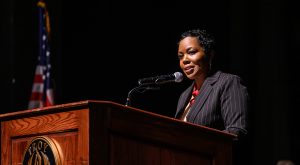
Dr. Dionne Rosser-Mims, Vice Chancellor of Troy University’s Montgomery Campus, encouraged participants in the John Robert Lewis Leadership Conference to exercise the type of leadership modeled by the late Congressman and Civil Rights leader — legacy leadership.
Dr. Rosser-Mims spoke during the conference’s opening session on Friday evening in the Trojan Center Theatre on the Troy Campus. Presented by the University and the City of Troy, the conference seeks to bring individuals together to promote dialogue that fosters multicultural collaboration to strengthen relationships and empower diverse leaders with the tools to better serve their organizations and communities. The theme for this year’s conference was “History as Power: Leadership Rooted in Legacy.”
“This conference is more than just an event,” Rosser-Mims said. “It is a living classroom, a space where the legacy of John Lewis becomes a leadership curriculum for every generation in this room. John Lewis is the one who said, and you’ve heard this before, you are a light. Never let anyone dim your light. This conference exists to help you protect that light, to strengthen it, sharpen it, and aim it toward justice. You are here to define your light, to reconnect with it, and to remember that your leadership is part of a much larger story.”
Rosser-Mims told conference participants that history was not a textbook, but rather a living inheritance. She shared the story of her uncle, Fred Moore, who, in 1961, became the first black guard at the Tomb of the Unknown Soldier.
“His appointment was more than a personal milestone. It was a historic breakthrough, and one of the most sacred traditions of military service,” she said. “His presence there said something profound, that service, excellence, and patriotism are not bound by race, even when institutions have been slow to recognize it. History is a testament to what happens when legacy meets purpose. It is also a reminder that history is carried not only by the famous who we study, but also by the everyday heroes, whose courage shifts the narrative expands what becomes possible for generations who follow.”
Rosser-Mims said her uncle embodied the type of leadership that Congressman Lewis modeled.
“It is leadership that understands we are standing on ground prepared by others, by those who came before us,” she said. “When we talk about protecting our light, we are not talking about something fragile. We are talking about a light shaped by history, sharpened by struggle, and strengthened by sacrifices of people like Sergeant Fred Moore, Congressman Lewis, Lamar Higgins, and countless others. Their examples remind us that our leadership is inherited, cultivated, and deeply connected to a lineage of courage. When we gather in rooms like this, filled with emerging leaders, seasoned leaders, and community builders, I believe we are not simply learning how to lead. We are learning how to honor the legacy we carry. How to steward the light entrusted to us, and how to ensure that the next generation inherits something brighter, stronger, and more just.”
Rosser-Mims pointed to three commitments that are essential in the practice of legacy leadership – radical self-awareness, radical empathy and radical imagination.
“Leadership begins with the courage to confront your own story, your own biases and, yes, even your own fears. It requires a discipline to grow the humility to listen, and the integrity to stay rooted in your values, even when the world pushes against them,” she said. “Radical empathy means recognizing that leadership is not about authority, it is about responsibility. Empathy doesn’t just open our hearts. It expands our vision. Radical imagination means to envision a future worthy of the sacrifices of those who came before you. Congressman Lewis asked us this. ‘If not us, then who? If not now, and when?’ That question is not just for students; it’s for all of us. Every generation represented in this room, this conference is the now, and you are the who.”
In closing, Rosser-Mims reminded the gathering that legacy is not a choice.
“My friends, we don’t get to choose whether we leave a legacy. We only choose what kind,” she said. “Every decision we make, every act of courage, every moment of integrity, becomes part of the leadership story this conference is preparing us to write. When we engage history constructively, we gain clarity, courage, and direction. The same spirit that carried Congressman John Lewis across that bridge, the same courage, that steadied Sergeant Fred Moore, as he guarded the sacred Tomb of the Unknown Soldier, the same quiet power held by countless unnamed leaders who answered history’s call, that spirit is still moving, still calling, still insisting that we rise.”
The John Robert Lewis Leadership Conference continued on Saturday with plenary sessions for youth and adult participants during the morning, followed by a closing luncheon session featuring the keynote address by TROY alumnus and television and film actor Sean Freeman.