In partnership with Alabama Humanities Alliance, Troy University’s Office of Civic Engagement brought history to life for Charles Henderson Middle School students with a new initiative aimed at preserving history and emphasizing the importance of storytelling.
Called “The Civic Tapestry: Weaving History into Public Life,” the initiative seeks to provide an opportunity for seventh grade students to better understand the critical role of history in public life by exploring local history through the experiences of seniors in the local community, as well as civil rights history through visiting the Legacy Museum in Montgomery, Alabama.
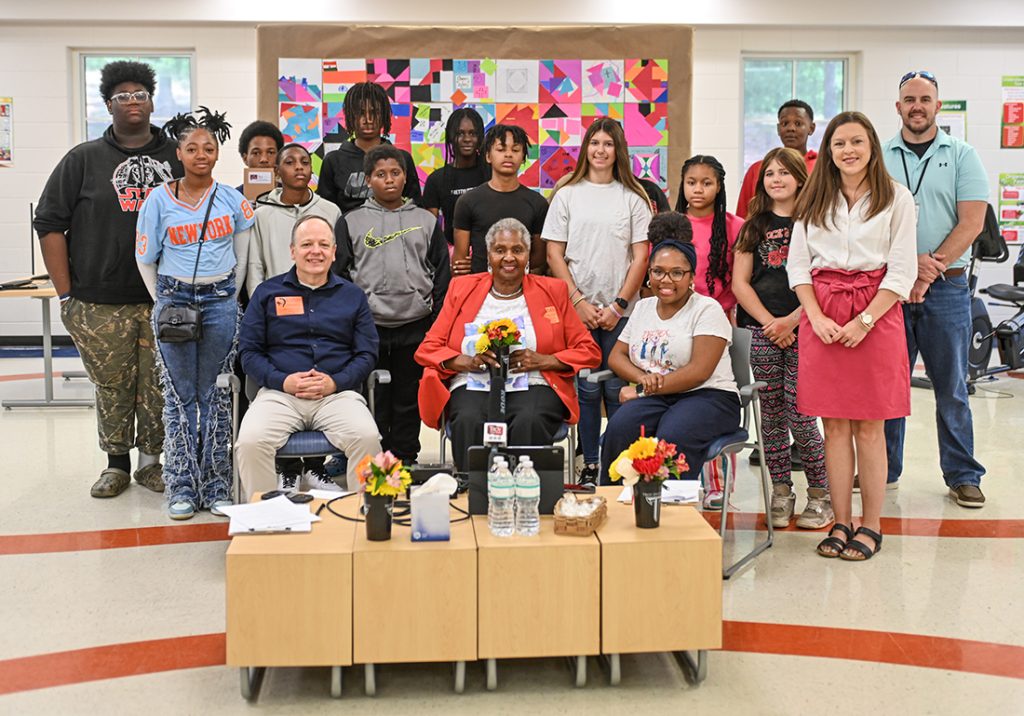
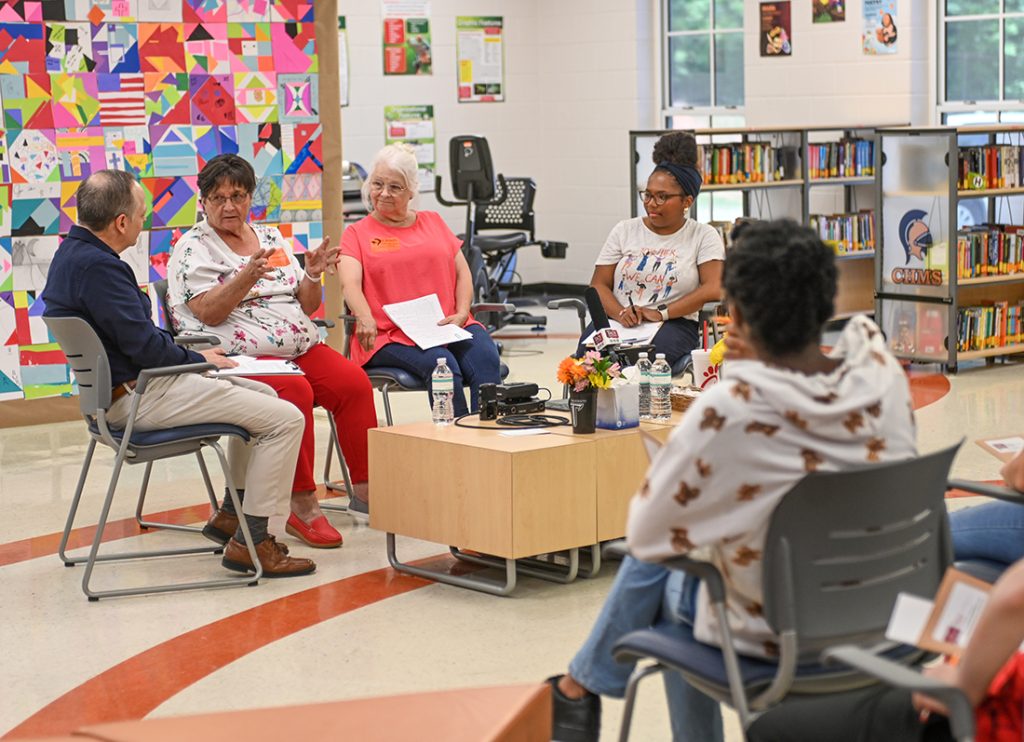
On May 2, local seniors were invited to Charles Henderson Middle School to participate in oral history interviews where students had the opportunity to learn about what life was like in their community. Students were able to submit questions. The interviews were recorded and will become a part of the Troy University Archives permanent collection.
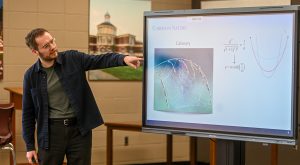
The interviews were facilitated by Jean O’Connor Snyder Program intern and TROY student Jayden McQueen and Dr. Mark Wilson, director of the Caroline Marshall Draughon Center for the Arts and Humanities at Auburn University.
McQueen, a junior political science major from Crestview, Florida, serves as the team leader of the “Civic Lab” initiative and was hands-on at every stage of the process.
“This initiative is aimed at facilitating dialogue and deliberation in our community, specifically our youth,” she said. “It serves to highlight the importance of history in our communities and why it’s important to engage in storytelling with others in our community. From crafting the idea, sharing the idea with the David Mathews Center—a proud sponsor of our work—grant-writing, the art project with the middle schoolers, getting volunteers and participants, you name it, my team of volunteers and I have worked tirelessly along with the coordinator of our office to make this event happen.”
The week prior to the interviews, the team visited the middle school to have discussions on the importance of identifying yourself in a community, identifying others in a community and why it is beneficial to ask the right questions.
“During this visit, the students participated in an ‘All About Me’ activity where they answered questions about their life, interests and values,” McQueen said. “Then they created a square sheet that would represent themselves in this larger paper quilt as a symbol that everyone in our community brings a beautiful quality and is a perfect piece to this beautiful tapestry that we call our community.”
Throughout the process, McQueen said she hoped the students learned the importance of staying curious about the people and places around you, especially in a historical context.
“Whether it was a nugget of wisdom, a life lesson or a funny story, this experience connected generations that wouldn’t have interacted to this magnitude,” she said. “I hope this inspires everyone, young and old, to be invested in their community, listen well and ask the right questions.”
Vernell Nelson grew up in Brundidge as the daughter of a sharecropper. She moved to New York at 17 and only recently returned to the area after the passing of her husband.
“This was the greatest experience; I wouldn’t have missed it for the world,” she said. “I love seeing the young people today—they have so many avenues that are open to them, so many great things and people in their corners that we could’ve never dreamed of growing up.”
Along with six other participants, Nelson shared her story of growing up in the South, her experiences in New York, moving up the corporate ladder as a black woman and how the lessons her father instilled in her carried her through life.
“I hope the students learned that education is the most important thing, and good grades don’t reflect learning,” she said. “Take the pieces of everything you’re learning and run with them. Be honest, be grateful, care about others and yourself.”
Jettadia bush, seventh grade history teacher at CHMS, said his class prepared for the event with studying civics questions and lessons on history through culture.
“The biggest thing is bridging the generational gap. The people who spoke have a wealth of knowledge that our students can learn from,” he said. “They’ve seen history and lived through things we can only read about in textbooks and imagine. It’s been great to be able to learn some things that may have been forgotten and try to carry those things forward with the next generation.”
Additional interview participants featured: Earl Ellis, Tellis Hill, Eula Crosskey, Lovell Martin, Barbara Atwell and Gwyn Owens.
About the Alabama Humanities Alliance
Founded in 1974, the nonprofit and nonpartisan Alabama Humanities Alliance serves as a state affiliate of the National Endowment for the Humanities. Through our grantmaking and public programming, we promote lifelong learning and impactful storytelling that lifts up our state. We believe the humanities can bring our communities together and help us better understand this dynamic and complex state we all call home. Learn more at alabamahumanities.org.