Nearly 600 middle and high school students from around the state flocked to the National Peanut Festival Fairgrounds on Tuesday for the second annual AgriSTEM Expo hosted by the Troy University chapter of Alabama Technology in Motion (ATIM).
Dr. Charisse Snell, TROY ATIM specialist and the event’s coordinator, said the goal of the expo is to show students the connection between STEM fields and agriculture and the growing career opportunities.
“From conversations with people in the industry, I’ve learned that some of our more seasoned farmers are really concerned that students now are going into other fields and are not looking into agriculture. They feel as though that it’s going to become a dying profession within the Wiregrass,” she said. “I’m trying to help students see there are other avenues in agriculture that will require them to learn science, math and technology because all of those things are being utilized in agriculture right now.”
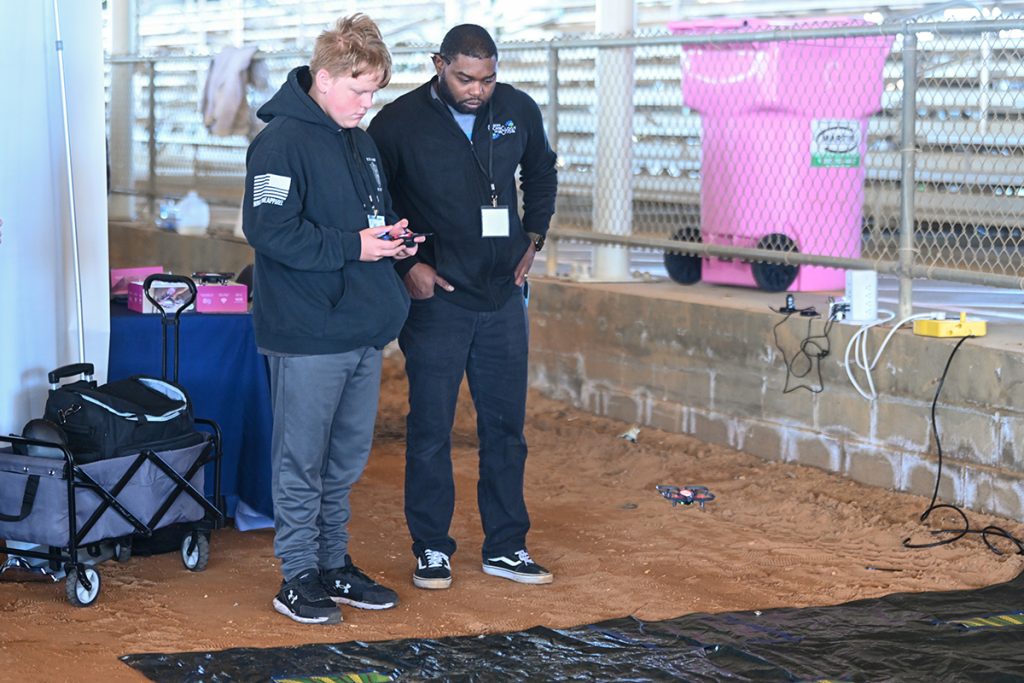
Through interactive exhibits and hands-on activities, students learned how STEM practices are integral to modern agricultural practices. Exhibits included a honeybee hive, 3D printing, drone flights, soil layering, micropipetting, excavator simulations, thermodynamics displays, robotics and more.

Troy University’s Department of Geospatial Informatics also set up an exhibit featuring a drone simulator and anaglyph stereo imagery and glasses.
“You prepare two images of the same scene taken from different locations so that they are colored—usually red and blue—and then printed together on the one page. You place the colored glasses on, and these limit what each eye can see to the appropriately colored image,” explained Dr. Bill Hazelton, associate professor. “Your brain then merges the two images into a 3-D view of what was in the image.
“With this, we can measure location and depth, creating a 3-D representation of the scene. There was one such stereo image taken by one of the rovers on Mars, which was used to map everything around the rover, track its movements each day, and plan for the next day’s activities.”
During the expo, Snell introduced a new tool from Swivel called M-2, an AI tool that helps teachers during instructional time by providing them with feedback on lesson plans and suggestions for improving classroom engagement.
“We used it at the expo to get students to interact with it and ask questions about certain agricultural careers,” she said. “Teachers interacted with it as well to talk about different types of instructional practices, like introducing agriculture and STEM to students in the classroom.”
Last year’s inaugural event hosted around 100 students, and Snell said she expects next year’s expo to grow again to possibly 1,000 based on the interest this year generated. As the world becomes increasingly technology-based, STEM fields and qualified professionals are going to be in high demand, making STEM knowledge from an early age invaluable.
“The STEM areas provide tools to learn about the world around us, and young children are almost insatiably curious,” Hazelton said. “Science and mathematics give us the best tools and methodologies that we have created in human history to understand and manage the world around us.”
Kelli Jo Wilson, a 21-year science teacher at Holtville Middle School, said she hopes this event inspires her students in their future studies.
“I really hope they take away a little bit of everything. Our science fair projects are coming up, so I hope this opens their minds and gives them some good ideas,” she said. “We are from a small agricultural town, and there’s so many kids that don’t know anything about STEM and agriculture and everything that goes with it, so this is very important.”
Lyla Patterson, an eighth grader at New Brockton Middle School, said she wanted to attend the expo to help her learn more about her environment.
“I really wanted to learn more agriculture STEM opportunities because I know it’s important for our local environment and the world,” she said. “I learned about microtip art and that we can get really, really tiny drops of water and create art, which is also really important because you use those microtips to collect DNA and other things.”
Molly Dignazio, also an eighth-grade student at New Brockton, said she learned about irrigation systems, bees, drones and videography and how they can all work together in different ways.
“I’m still deciding what I want to do when I get older, and it’s almost overwhelming to see how many options there are that we didn’t know about before today,” she said. “But I think it’s really important for students to know about STEM and the different jobs you can do in those fields.”
For more information on Alabama Technology in Motion and its services, visit here.