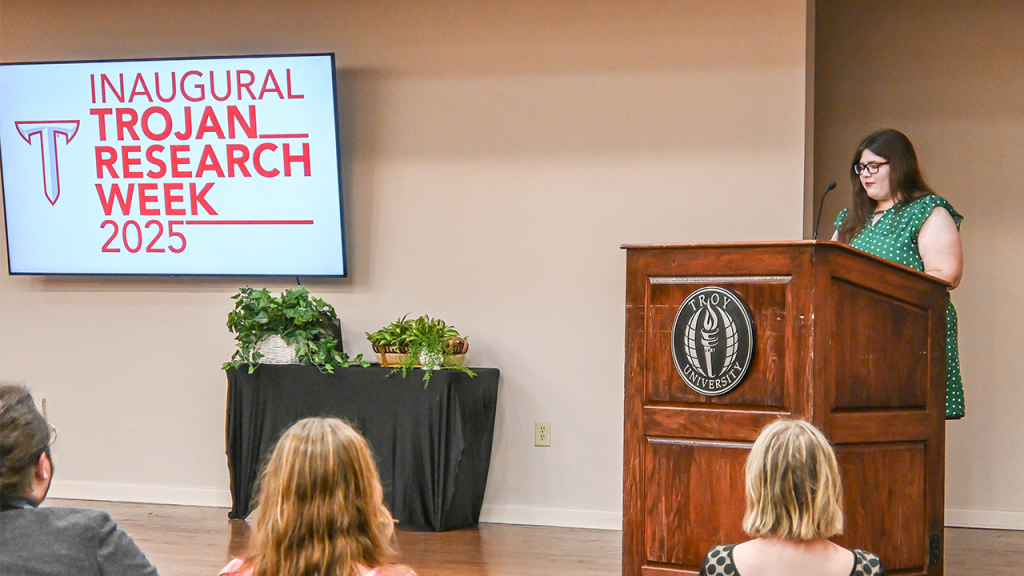
On Monday, April 21, eight students in TROY’s College of Communication and Fine Arts presented research as part of the inaugural Trojan Research Week.
During the kickoff event for research week, Dr. Thrasher, Dean of the College of Communication and Fine Arts, gave comments on the importance of research.
“Research begins with curiosity and learning more about the world around us,” Dr. Thrasher said. “There is an immense amount of information that we don’t yet understand, and when we have that intellectual curiosity to explore new things, it enriches us, our life, our experiences and those around us.”
The event featured poster displays, performances and presentations by students from the John M. Long School of Music and the English department. Dr. Ben Robertson, Professor of English and organizer for CCFA’s research presentation day, says that the event was an excellent opportunity for students to share their research publicly.
“Presenting one’s research this way is scary, especially for students who may never have done this kind of activity, so the fact that these students decided to participate tells us that they’re a truly special group,” Dr. Robertson said. “The posters, presentations, and performances by these students were undertaken, not for grades, but for the sake of the experience itself. The students practiced critical public speaking skills while also adding a significant line of experience to their résumés. I’m extremely proud of them for their work, and I know the rest of the faculty are as well.”
Kensley Fuller, a first year Choral Music Education graduate student from Chelsea, Alabama, presented on “The Impact of Popular Media on Student Engagement and Music Pedagogy.”
“I was interested in this topic because educators are experiencing an increasing need for tools to engage students in the current tech-centered and social-media centered culture,” Fuller said. “Connecting to students and building classroom culture is key for a positive learning environment, so I wanted to learn more about how to do that.”
While never having presented research before, Fuller says that it has inspired her to keep learning and presenting research in the future.
“I met many others interested in my research and built connections with other researchers, finding that we can be stronger together when we collaborate to research and take action about the same things,” she said.
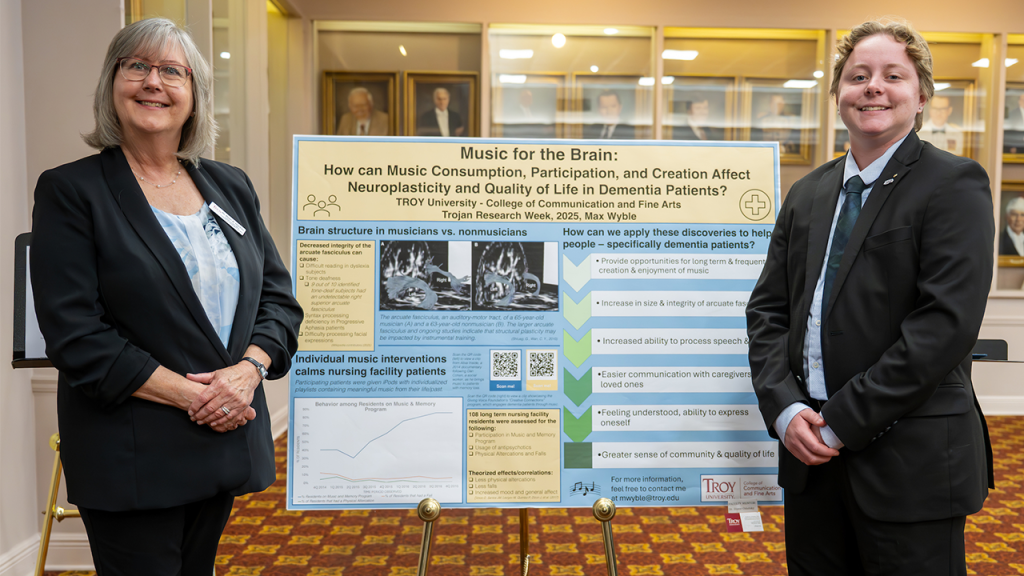
Some student’s interests began long before they came to TROY. As a teenager, Max Wyble, a junior Music Education major from Panama City, Florida, had an interest in music cognition and the effect that music has on the brain. This interest turned into Wyble’s research for “Music for the Brain: How Can Music Consumption, Participation and Creation Affect Neuroplasticity and Quality of Life in Dementia Patients?”
“I was always extremely fascinated by why music is so powerful on our mood and mental health, and I wondered if it had any concrete effect on the brain,” Wyble said. “I began researching this topic more in depth as I began preparing to apply for graduate schools in music cognition and perception. I thoroughly enjoyed presenting during the Trojan Research Week, especially getting to answer questions that people had about my research and the general field.”
Anais Shelley, a junior English major from Danzey, Alabama, wrote a research paper that was inspired by an assignment for class.
“My paper titled ‘Sermon in Disguise: The Religious Implications of Robinson Crusoe’ was born out of my first reading of the book for a class called English Novel,” Shelley explained. “I used the themes of spirituality within this text and applied them to the historical importance of Enlightenment views on religion, manliness, and novels, three things I never realized would have tied together so greatly.”
The other CCFA students who presented during the inaugural Trojan Research Week are as follows:
Jerod Kimbro: “The Integration and Impact of Digital Technology in Elementary Music Education: Analyzing Pedagogical Approaches and Student Learning”
Kaitlyn Pharr: “Music Performance Anxiety in Upper Elementary Students”
Mia Sanchez: “Exploring Samuel Barber’s Four Songs, Op. 13 for Use in the Undergraduate Vocal Studio”
Gabriel Clemmons: “Metamorphosis: The Power of Story Telling Through Music”
Madeline Birge: “Marginalized Thread: Marie de France’s ‘Bisclavret’ and Political Cues of Clothing”