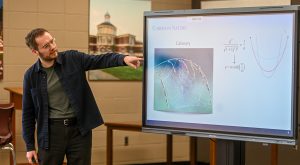
Over his last seven months as a Fulbright Scholar, Dr. Jiří Minarčík has traveled across the United States speaking to students eager to learn and fellow math-minded researchers. During his week in Troy, Alabama, he gave lectures and met University officials, but also tried banana pudding and fried okra for the first time.
A native of Velké Karlovice, Czech Republic, Minarčík arrived at Carnegie Mellon University in Pittsburgh, Pennsylvania, in Sept. 2025, where he collaborates with Professor Keenan Crane on applications of geometric flows in computer graphics and computational geometry.
“I’ve studied different things throughout my life, but I always return to the one topic I love the most, which is analysis and exploration of geometric flows,” he said. “Very simply, this is exploring how various manifolds—curves and surfaces—change and evolve over time. There are a lot of mathematical ways to express these changes, and I like finding connections to these mathematical abstracts to what we see in nature, like tornados or smoke rings as I presented this week.
“There are a lot of real-world applications for the work that I’m doing,” he continued. “Many different kinds of computer simulations, graphics, animations, modelings. Anything geometry can be applied to, which is many things.”
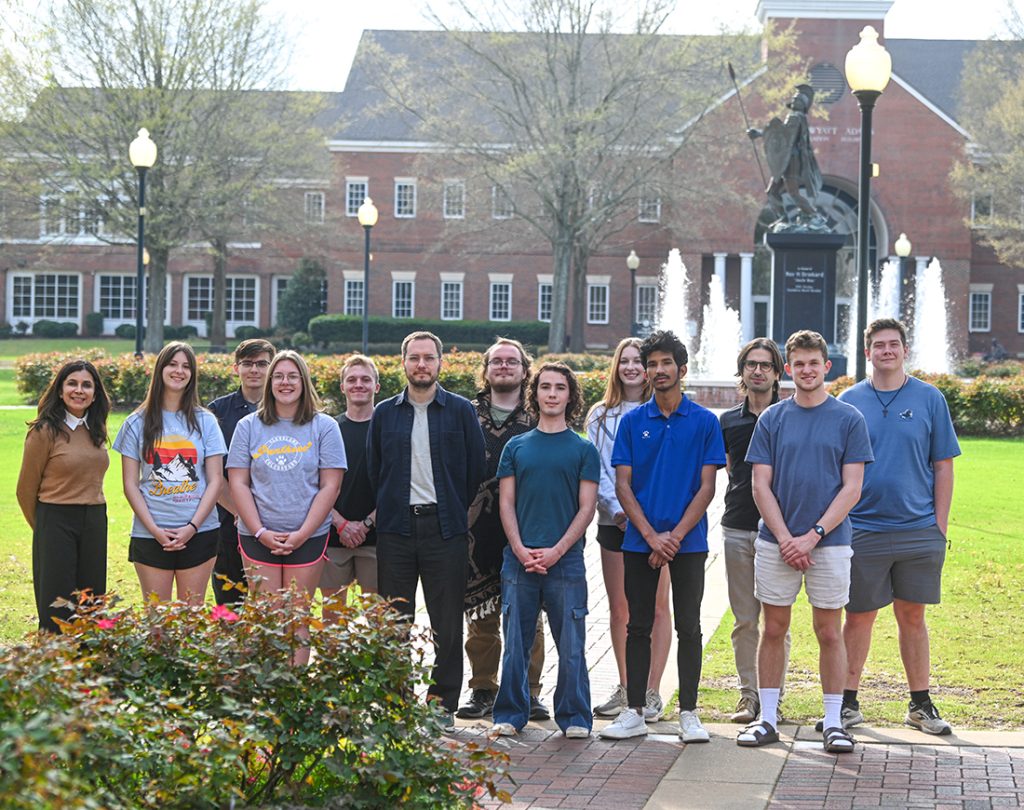
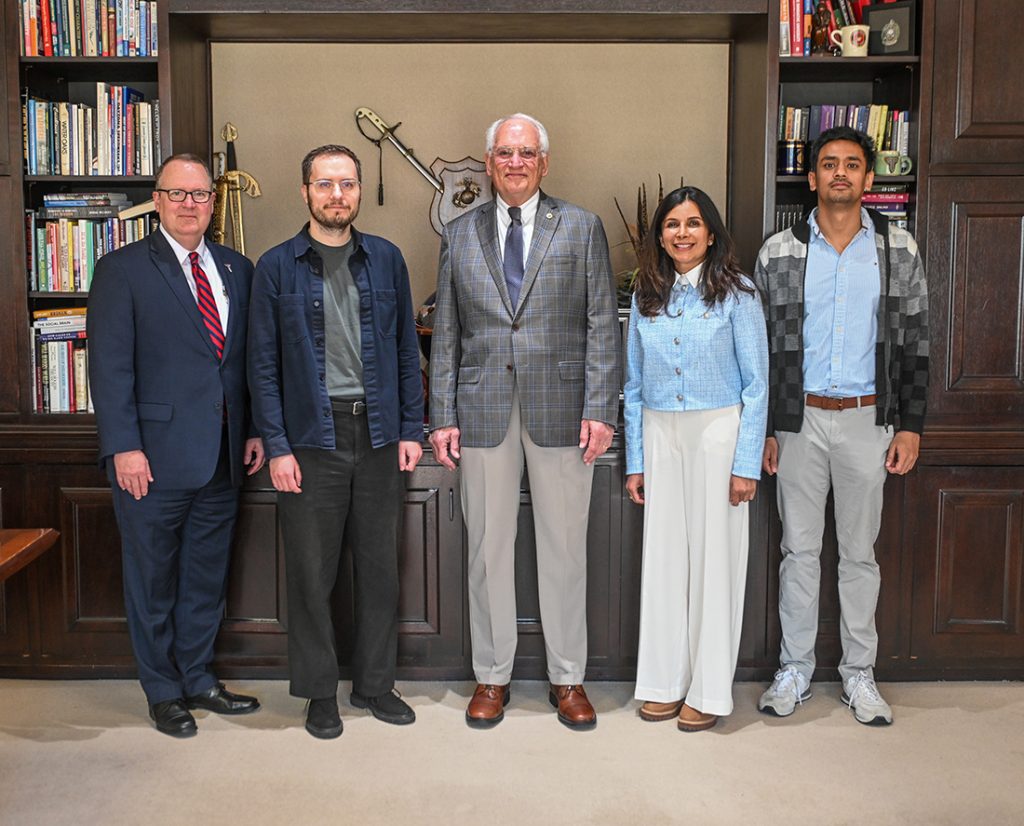
While at TROY, Minarčík hosted several public lectures on geometric flows, Hasimoto fractals and codimension geometric flows. He also participated in a Fulbright panel with Dr. Nicole Camastra and spent time meeting with the UHGSP honors classes and mathematics and physics faculty within the College of Science and Engineering.
On his last day with TROY, he toured the Rosa Parks Museum in Montgomery, Alabama, to learn more about the Civil Rights Movement and ate at a local staple, Dreamland BBQ, to experience true Southern cuisine.
“I really enjoyed both the atmosphere and the food at the BBQ restaurant,” he said. “It was my first time trying okra—I didn’t even know what it was before—and I’m a fan now. I especially liked the banana pudding. I’ll try the sweet tea next time!”
Though not his first visit to the United States, this is Minarčík’s first extended stay. In between conferences and speaking engagements in New York, Texas, California, Illinois, Massachusetts, Nevada, Rhode Island and Washington, D.C. he’s been able to have personal vacation time with his wife in Miami—a new favorite city.
“Everything has been great so far. The only problem for me has not been walking, since you need a car to go most places,” he laughed. “I’ve really loved the weather and the environments, the nature here is beautiful. The people here at the University have been very nice, very helpful. I felt very welcomed.”
Hosted by the Center for Relativity and Cosmology and the University Honors Global Scholars Program through a Fulbright Outreach Lecturing Fund grant (OLF), Minarčík’s visit marks the beginning of a broader initiative to bring leading international scholars to campus, fostering collaboration and expanding opportunities for student engagement with active researchers.
“Without Fulbright I probably would not have ever been able to visit TROY, and I’m glad to be here,” he said. “We do not work in the same fields, but I can understand most of their research and they can understand most of what I’m working on. We’ve been able to have a lot of useful conversations about where our research overlaps, and it’s been very interesting.”
Minarčík earned his Ph.D. in mathematics from the Czech Technical University in Prague in 2024. In addition to his academic work, he spent six years as a founding researcher at Resistant AI, applying mathematics and machine learning to fraud detection and anti-money laundering.

“The impact Fulbright will have on my career is huge, I think,” he said. “Without Fulbright, I don’t know if I would still be in academia in a full-time manner, since I am still involved with various companies and would be doing more business-related things. I love this topic, so this has made it possible for me to put more effort into my research.”
To students and faculty considering applying for a Fulbright grant, Minarčík said to really consider your why—and take the plunge.
“My way into Fulbright was a bit different than what people usually do. I was focused on one specific professor I wanted to work with in one specific place,” he said. “The application process was relatively hard because I really wanted to get in, so I put everything I had into it with no other plan B.
“The first step I did, and that I recommend to others, is find someone connected to Fulbright who did it before in your field and ask many questions. Apply, and even if you don’t get it the first time keep trying. Think about your story and how to tell what you’re doing and what your passion is. Show them who you are.”
After leaving TROY, Minarčík traveled to Boston, Massachusetts for another conference, visited research groups in New Haven, Connecticut, and London and is currently in Paris.
Those interested in applying for a Fulbright OLF grant or learning more about the program, click here.