Luis Martinez III never expected to be standing in a room with a Pro Football Hall of Fame Award of Character in his hands.
He expected to keep doing the next thing that needed to be done.
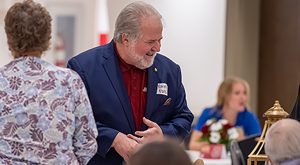
Martinez, chairman of the All Veterans Council of Tom Green County and a veteran resource and referral specialist with the Texas Veteran Leadership Program, received one of the Hall’s inaugural Awards of Character this summer in San Angelo, Texas. Hall of Famer Kevin Mawae and Brittney Payton, daughter of Pro Football Hall of Famer Walter Payton, surprised him at the veterans’ facility.
“We don’t do it for the accolades. We don’t do it for the awards. We do it because it needs to be done,” Martinez said.
If he saw a gap, he filled it. That, more than any ceremony, is how he describes the work.
Martinez enlisted in the U.S. Air Force in November 1996 and served nearly 16 years with the 820th RED HORSE Squadron and the 99th Civil Engineering Squadron, including deployments to Iraq and Afghanistan. He was wounded in 2009 when the vehicle he was traveling in struck an IED in Tikrit, Iraq. He holds three Purple Hearts.
After leaving the service, he raised four children largely on his own. Following back surgery, he spent a year paralyzed from the waist down while he learned to walk again. His youngest was in kindergarten. His oldest was a freshman in high school.
“In the military, that was family. They were like, hey, we got you,” he said. “That’s the same mentality now. When people are in the mud, it’s meeting them where they’re at. Let me go to you.”
He later returned to school and earned a bachelor’s degree in social work from Howard College, Angelo State University (BSW), and Troy University (MSW).
He did it because he had already told his children they needed to go to college. He wanted them to see him do the same.
The work itself was not complicated, he said. It was consistent. Homework got done at practices, at games and anywhere else a notebook would fit.
“It’s worth it,” he said.
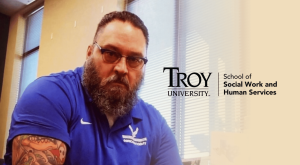
That same habit of showing up is what colleagues in San Angelo point to when they talk about him. People who do not know him often say he looks intimidating.
“Once I start talking, it’s to the point. I don’t sugarcoat anything,” Martinez said. “If I say we can’t do it that way, let’s find another way. I’m never going to say that’s it, we can’t, and that’s the end.”
He helped start a PTSD support group, a food pantry and the first women’s veterans group in the region. A few years ago, the community realized it had gone a stretch without losing a veteran to suicide. Martinez said the number was a shock. They did not set out to announce it. They started calling organizations and no one had a name to report.
He believes that outcome is tied to the same idea that drives the rest of the work: fill the gaps and make a space where everyone can stand.
He tells the veterans he serves to do the same.
“A large part of a soldier’s identity”, Martinez said,” is providing for the country. When they come home, many of them no longer know how. The mission has ended. The purpose did not automatically transfer.”
“Be part of the community,” he tells them. “If there is a gap, fill it.”
That work, he said, gives them a new sense of purpose.
The conversation about benefits is harder. Martinez hears the same sentence over and over: I don’t deserve it. He used to skip the free Veterans Day meal and the reserved parking himself. He still encourages veterans who are struggling to use both — and to take someone with them who needs it more — so businesses keep offering.
When the subject is a claim, he changes who the benefit is for.
“You’re not doing this for you. We’re doing this for your family,” he said.
He tells them to accept it, so they can give it to their wife, child, even their grandchildren. A service connection can mean education benefits for a spouse or a child. It can mean survivor benefits. Once veterans hear it that way they usually turn around on the idea quickly.
Troy University has long-standing ties to the military, and the University’s social work program includes research focused on military families. Martinez’s advice to social work students is direct.
“Have thick skin. Follow through. Veterans have often already been through a long line of offices before they reach you. If you promise the work and do not do it, they will not come back, and they will tell the next person not to come either.”
He also told students not to treat every veteran like the same case.
“Troy gives you an amazing foundation to build off of, but you’re allowed to build on top of that,” Martinez said. “Don’t be afraid to build on top of that. Not everyone’s cookie-cutter.”