When we think of World War I, we conjure visions of horrible trench warfare, machine guns, gas attacks, and endless mud. We also note how quickly the American Expeditionary Force demobilized after the Armistice of November 11, 1918.
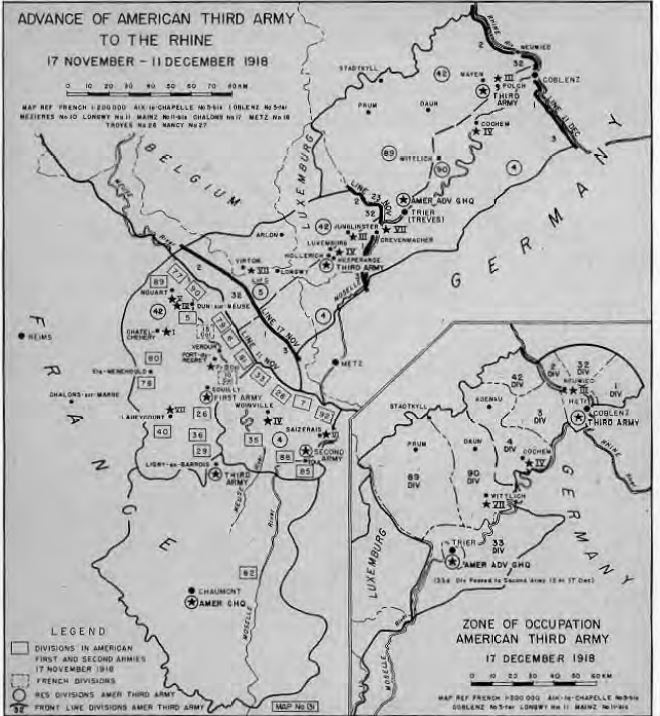
Few of us think about the 250,000 troops of the US Third Army, created just four days before the Armistice, that occupied the Coblenz Bridgehead and a 2500 square mile sector of the Rhineland from December 1918 until January 1923 (re-designated as the “American Forces in Germany” after July 2, 1919).
One of those occupiers was Dr. Arthur Keyton of Dothan. In August 1919, he was joined in Coblenz and Sinzig, Germany, by his wife, Joyce Williams of Norwich, Connecticut.
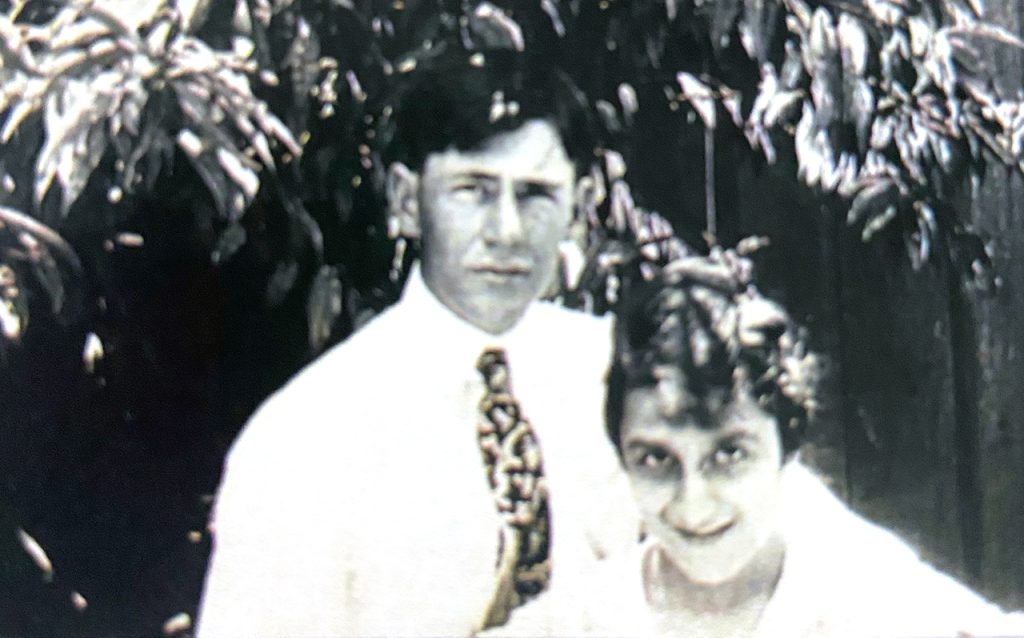
The Wiregrass Archives holds 44 letters written by Arthur and Joyce to each other and to their families in Connecticut and Alabama. We have posted copies of the originals and transcripts to the web at the link below.
Born in 1893, Arthur attended Howard College (now Samford University) then Tulane Medical College. Alabama licensed him to practice medicine in 1916, after which he interned at Backus Hospital in Norwich. While there, he met, courted, then, on May 16, 1917, married Joyce Katherine Williams (b. 1896) of Norwich in a family ceremony presided over by the local Episcopal rector. The couple left for Dothan where Arthur planned to set up a medical practice.
But war intervened. Congress declared war against the Central Powers on April 6, 1917, and on May 1, Arthur joined 35 other Norwich physicians in pledging to join the Medical Reserves. On June 5, the same day that he registered for the first military draft in the US since the Civil War, Arthur received his commission as a First Lieutenant in the Office Reserve Corps. The Army ordered him to its medical school in Washington, DC, in late July, then to Fort Oglethorpe in early August. Joyce remained behind with her in-laws in Dothan until joining Arthur in Chattanooga near his Georgia post.
<Insert “Arthur Keyton in WW1 uniform.jpg”>
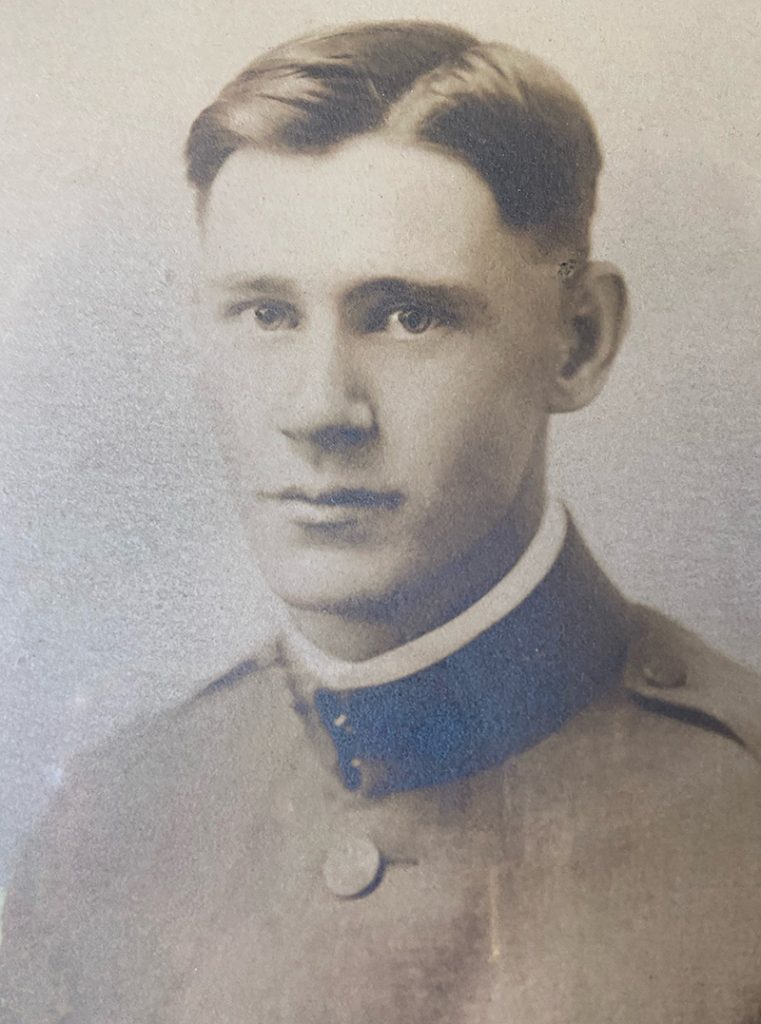
Joyce and Arthur traveled together to his next station, Camp Meade in Baltimore, where he was promoted to Captain and was likely assigned to the 79th Infantry Division (it seems that Arthur’s military records were destroyed in the 1973 National Archives Military Record Center fire in St. Louis). In July 1918, Arthur deployed to France and Joyce returned to live with the Keyton family in Dothan.
One thing that tells us that Arthur deployed with the 79th ID was a letter Joyce sent to him at the 79th Division Surgeon’s office on September 30, 1918. If this was his outfit, he saw the terrible consequences of World War I when the undertrained and ill-supported 79th made a deadly assault on the German observation post at Montfaucon on September 26 as part of the Meuse-Argonne offensive. One writer estimates that the division lost 2000 men at Montfaucon.[1] That offensive continued until the Armistice took effect on November 11.
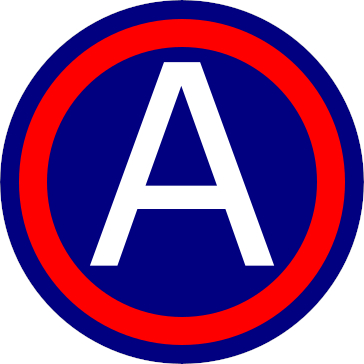
Four days before the Armistice, on November 7, 1918, the American Expeditionary Force created the US Third Army designed to occupy a sector of the Rhineland from France through Belgium and Luxembourg to the Coblenz Bridgehead. The Third Army’s unit patch signifies its mission: an A for American inside an O for Occupation. The American Occupation sector was between the British sector to its north and the French to its south.
Arthur Keyton found himself assigned to the Third Division’s surgeon’s office in Andernach, Germany by May 1919, then to Evacuation Hospital No. 27 in Coblenz in July.
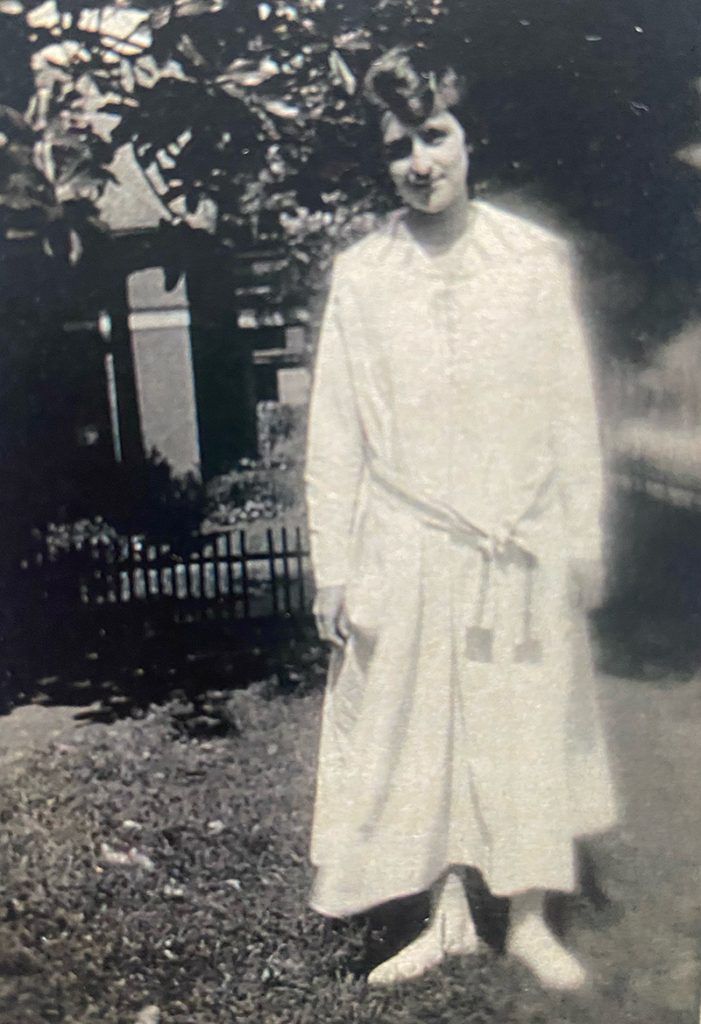
Negotiations over the Treaty of Versailles ran from January through June 1919, and consternation spread in the Third Army that the Germans might refuse to sign, leading to renewed war. But the Germans did sign, so the Third Army “dissolved” on July 2, 1919, to become the American Forces in Germany, the AFG. Better yet, officers could send for their wives.
Joyce and her mother Annie had stayed in Dothan with the Keytons between August 1918 and April 1, 1919, when they returned to Connecticut. Joyce and Arthur were anxious to reunite, and in a letter to her in-laws, Joyce told John Keyton, “Father . . . I am going to expect you to help me out on the fare.” Joyce arrived in Coblenz with three other officers’ wives on September 10.
We don’t hear from the Coblenz Keytons again until November 22 when Joyce reported that they had moved to the hamlet of Sinzig at the northern boundary of the American sector. Arthur wrote home the same day, excusing his communications lassitude because “I’ve been so busy getting acquainted with my wife that I have had a lapse of memory or something.”
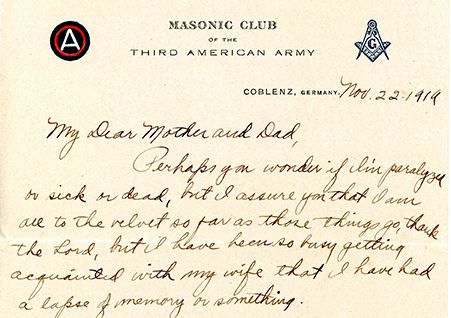
Arthur and Joyce had plans for their future and wanted to save money for a nest egg. Sinzig, they thought, was small enough that they could avoid parties and “live frugally.” But frugality didn’t mean poverty. For Thanksgiving, 1919, they lunched with Arthur’s unit at the YMCA on stuffed turkey, mashed potatoes, peas, rolls with jelly, apple pie a la mode, pumpkin pie, and doughnuts. At home that evening, they ate more turkey with chestnut stuffing, potatoes, beets, cranberry sauce, chicken salad, cake, gelatin with fruit and nuts, pie, doughnuts, and fruit. Joyce wrote to her mother that she was inundated with cherries, and another time wrote that Arthur had interrupted her with two liters of ice cream. She also wrote that they both had gained so much weight that her mother wouldn’t recognize either of them. Joyce employed both a cook and a housemaid but occasionally made desserts.
<insert “256-20-0701-001-011-005.jpg”>

The Army transferred Arthur from Sinzig to Coblenz in late 1919, and social functions replaced frugal family life. Dining with friends, military events and celebrations, theater, and other entertainments fill the letters Joyce and Arthur wrote to their parents.
Even so, the couple longed for home. Arthur began asking his commanding officer about demobilizing in January 1920 but discovered he had to be in the army for two full years before they’d consider sending him home. July 10, 1920, was his anniversary and as it approached, both Arthur and Joyce planned for the future. Dr. William Gorgas – fellow Alabamian, conqueror of yellow fever, and the Army’s surgeon general – was to help Arthur secure a position in New York, but as luck would have it, Gorgas died on July 3.
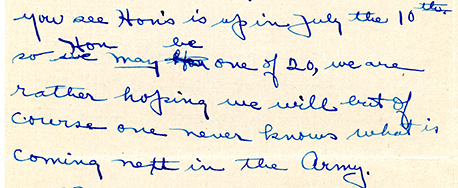
Throughout the Spring of 1920, Joyce and Arthur fretted. On May 12, rumors circulated that 10 physicians were to be ordered home, with 20 more to follow. Arthur hoped he’d be in the second group, but as Joyce wrote, “one never knows what is coming next in the Army.” By June 5, rumors spread that all US troops were leaving Germany by September. In the collection’s last letter, from Arthur to his mother-in-law on June 27, 1920, he wrote that the couple was returning home soon, but couldn’t say when, and that he was going to resign from the Army and work for himself.
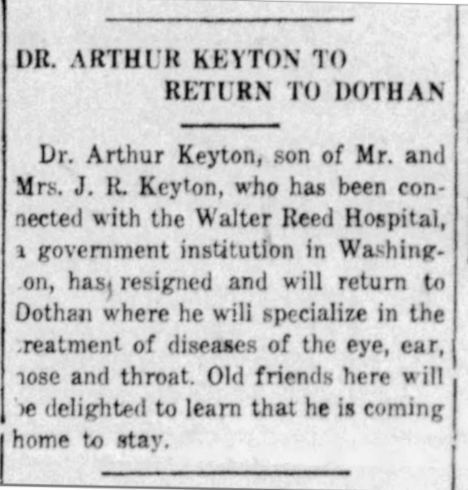
This did not pan out for another six months. US troops stayed in Germany until January 1923, though the Keytons returned to the US in late-January 1921. But good news, in October 1920, Arthur had received a promotion to Captain in the Regular Army (after being discharged from the Officer Reserve Corps on June 30, 1920), and while he didn’t resign from the Army when he returned, he was stationed with the attending surgeon of Washington DC, then worked at Walter Reed Hospital from September 1922 until resigning from the Army in February 1923.
The Keytons moved back to Dothan where Arthur set up his Ear, Nose, and Throat practice between Blumberg’s Department Store and Porter Hardware on Main Street. On October 11, 1922, Joyce and Arthur’s daughter, Elizabeth, had been born in Washington, and on September 28, 1925, Arthur, Jr. was born in Dothan. Arthur and Joyce, joined by her mother Annie, remained in Dothan for the rest of their lives.
You can find more about the Keyton Family Collection (Wiregrass Archives Record Group 256) at this link: https://www.troy.edu/about-us/dothan-campus/wiregrass-archives/inventories/256.html (the WW1 correspondence is located in files 256-20-0701-001-010 through 014).
[1] William Walker, Betrayal at Little Gibraltar: A German Fortress, a Treacherous American General, and the Battle to End World War I (Scribner, 2016), 177.