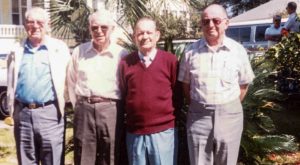
Kelly Reeves from the Troy University Library shares a collection of correspondence and photographs recently digitized and made available at this link: Barker Collection of WWII Letters – Troy University Archives. The collection’s 257 handwritten letters and 84 “V-Mails” (all transcribed) traces Earl Barker’s time in the US Army, 1943-1945.
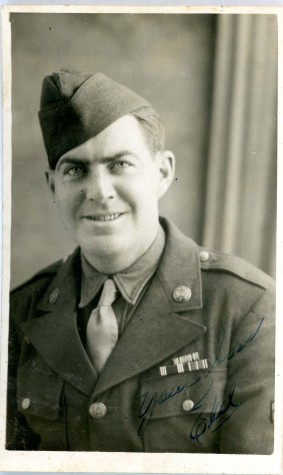
[Note: Research in the Wade Hall Postcard Collection for the exhibit “Military Service: A History in Postcards” (https://today.troy.edu/news/it-came-from-the-archives-halls-a-history-in-postcards-presented-in-a-troy-libraries-exhibit/) , Kelly found postcards from the Barkers. He contacted the family, and Clara J. Barker, daughter in law of Earl and Ruth Barker, donated the collection in 2020.]
Earl Barker (1915-1993) married Ruth Weatherly (1920-2005) in 1941 in Kentucky. He was inducted in September 1942, three days before the birth of his son, Taylor Earl, Jr. (“Mokey”). Barker trained at Camp Campbell, KY, was promoted to corporal, then in 1944 transferred to Camp Gordon Johnston in Carrabelle, FL for assignment to the 341st Harbor Craft Company as a submarine spotter in the Gulf. In August 1944, Barker was transferred to England with the 62nd Traffic Regulation Battalion, and in 1945 deployed through France, Belgium, and Germany. He returned to the States in November.
In 1944, Ruth and Mokey moved to Detroit where Ruth’s parents lived. She worked in a factory there until Earl returned. She later became an elementary school teacher.
BARKER’S CORRESPONDENCE TO RUTH (curated by Kelly Reeves; transcriptions retain original spelling and grammar)
This is “the departure postcard” Earl wrote to Ruth as he left New York for England. It speaks of censorship and troop secrecy.
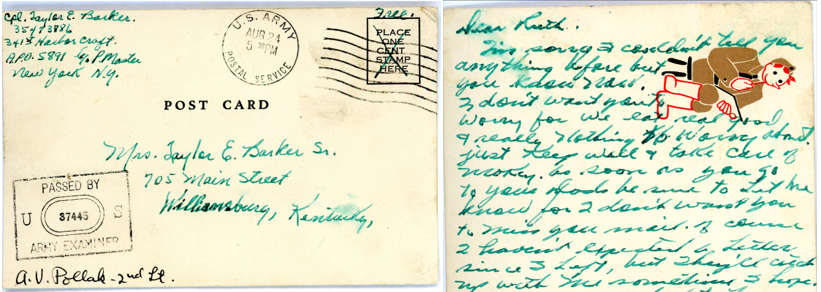
(August 24, 1944 – Earl to Ruth) — Dear Ruth, I’m sorry I couldn’t tell you anything before but you know now. I don’t want you to worry for we eat real good & really nothing to worry about.
While in Europe, he was required to burn letters he received from home. This is one reason why so many collections of soldiers’ letters are one-sided.
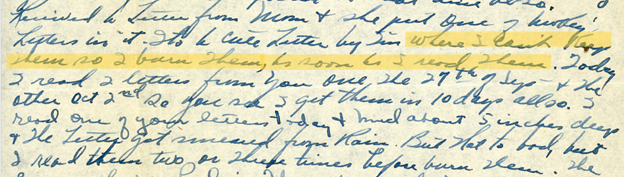
(October 12, 1944 – Earl to Ruth) — Received a Letter from Mom & she put one of Mokey’s Letters in it. It’s a cute Letter but I’m where I can’t Keep them so I burn them, as soon as I read them.
“V-mail” (Victory Mail, June 1942-November 1945) was a system to reduce the physical bulk of the billions of pieces of mail the Army Post Office handled. Soldiers used a special form that was microfilmed, the microfilm was sent to the States, and the APO printed the V-mail for delivery.
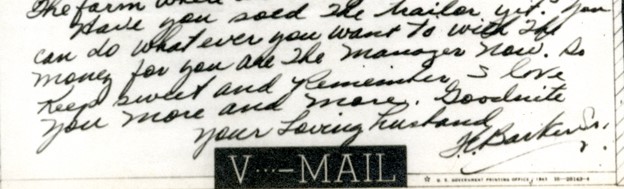
(V-Mail 10/28/1944, Earl to Ruth from England) – Have you sold the trailer yet? You can do what ever you want to with the money for you are the manager now. So keep sweet and remember I love you more and more. Goodnite
Having just arrive in Europe from England as the Allies pushed toward Germany, Earl describes the French countryside and the war.
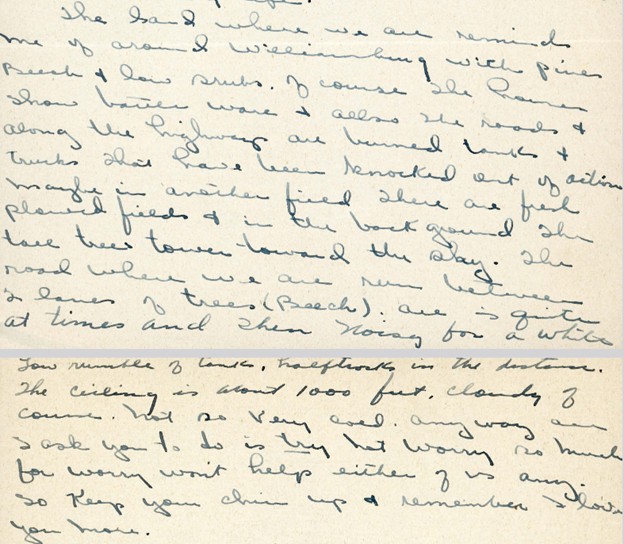
(Letter 03/17/1945, Earl to Ruth from France)… The land where we are reminds me of around Williamsburg with pines Beech & low srubs of course the homes show better ware & also the roads & along the highways are burned tanks & trucks that have been knocked out of action maybe in another field there are fresh plowed fields & in the background the tall trees tower toward the sky. The road where we are runs between 2 lanes of trees (Beech) All is quite at times and then noisy for a while Low rumble of tanks, halftracks in the distance.
Earl described his arrival in Germany as the Wehrmacht retreated.

(Letter 06/29/1945, Earl to Ruth, Lauterbach Germany). – . . . So you see the alps have everything. Yesterday I drove to the olypic stadium where the 1936 Olympics were held. There was a big Stadium where Hitler made his promises & etc. . . . Yes. I allso went by the SS barracks where 5000 Nazi lived & their out door sport field was more beautiful Than any I’ve ever had seen in the states marble of course the eagles & the 卐 were torn down but were piled by.
Life in Germany was hard in the wake of Germany’s surrender.

(Letter 08/04/1945, Earl to Ruth from Germany) Honey, this Country is in bad shape I mean the people. today I was driving & Little Kids from Mokey’s size on up were along the streets eating this dry German black bread. I pulled into a place to get me something to eat & the Kids & allso old people were at the dump. (where the GI’s throw their cans.) Licking & eating what was left in the cans. I’m so soft hearted . . .
Earl sees the light at the end of the tunnel in September 1945. Turns out that light is the home fires. He describes some war experiences.
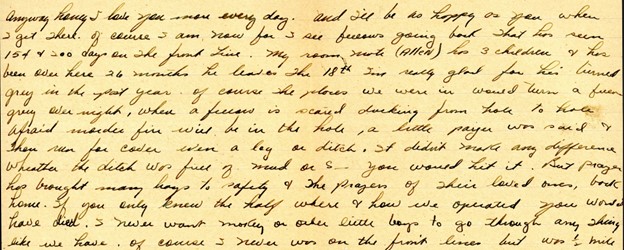
(Letter 09/09/1945, Earl to Ruth) — . . . I see fellows going back that has seen 154 & 200 days on the front Line. My room mate (Allen) has 3 children & hes been over here 26 months . . . of course the places we were in would turn a fellow grey over night, when a fellow is scared . . . run for cover even a log or ditch, It didn’t make any difference wheather the ditch was full of mud or s you would hit it. . . . If you only knew the half where & how we operated you would have died. I never want Mokey or other little boys to go through any thing like we have. . . .
Every collection of correspondence from and to soldiers at war show us the personal side of lives diverted toward national service. You can find digital surrogates of the Barker Collection of letters, V-mail, photos, postcards, and transcripts at this link: Barker Collection of WWII Letters – Troy University Archives .


