The Troy University Arboretum is buzzing with new activity thanks to two major initiatives aimed at education, conservation and hands-on student learning.
Made possible with the support of a $5,000 grant from Wiregrass Resource, Conservation and Development Council (Wiregrass RC&D), the arboretum will soon be installing a honeybee observation hive.
“Like most of what we do, this is an educational addition to the arboretum,” said Dr. Alvin Diamond, biology professor and Director of the arboretum. “We want to educate people about the declining honeybee populations and their importance, but we want to extend it to all pollinators. Many of our native pollinators are declining even worse, like carpenter bees. We’re working on several different projects, but this one goes along with our pollinator garden, our Monarch waystation for the Monarch butterflies and our wildflower meadow area.”
According to Diamond, honeybee populations have experienced a serious decline in recent years. Typically, a colony is made up of tens of thousands of bees, and normal population loss ranges between 15-20 percent due to age, predation, weather and other natural factors. But for the last 15 years, Diamond said that number has gone up to about 40 percent per year.
“We’re losing almost half of our honeybee population every year. This year, many areas are experiencing 60-70 percent colony loss,” he said. “Theres no one reason, but a lot of contributing factors: parasites and diseases infiltrating colonies, overuse of pesticides that are killing bees, the overall decline of habitat because of clearing more areas for developments and housing, climate variability. About 70-75 percent of the things we eat require bees and other pollinators, so it’s not just that the bees are disappearing, it’s directly affecting other areas of our life.”
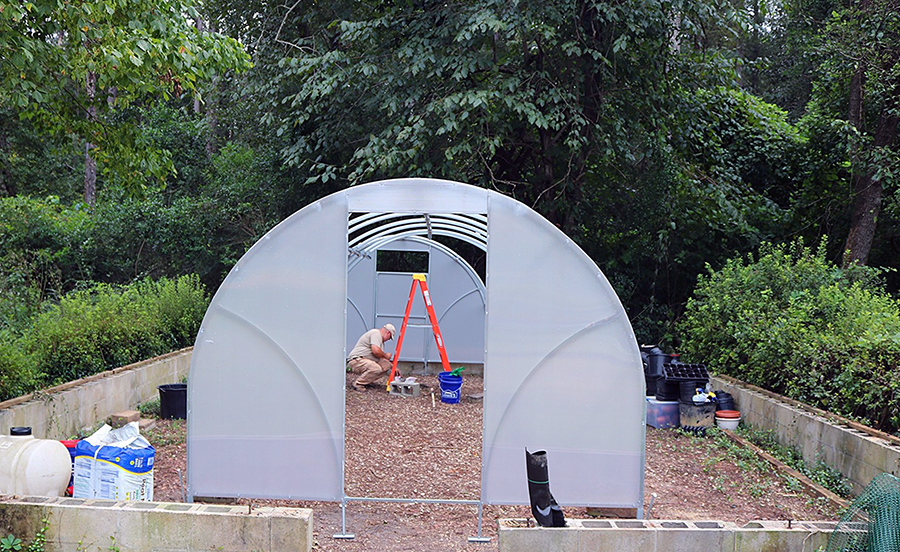
In addition to the observation hive, arboretum staff and volunteers are currently building a new greenhouse thanks to a $5,000 grant from Hyundai Motor Manufacturing Alabama’s (HMMA) Charitable Giving Program.
Used for many years to grow native and exotic plants like orchids, vermilion and cacti, the former greenhouse was donated by Dr. Henry Bridges of Bainbridge, Georgia, and fell into disrepair.
Because of the grant from HMMA, students will once again be able to grow plants, conduct research and receive hands-on learning through every step of the process.
“It’ll be a great benefit to us not only in saving money on buying plants from nurseries, it gives students experience,” Diamond said. “We have a student, Fisher Parrish, who’s doing graduate work restoring pitcher plants who will be able to use the new facility for his research. That’s a huge upgrade for him.”
This is the second grant the arboretum has received from HMMA. The first, $25,000 also from the Charitable Giving Program, allowed for the installation of a floating dock and a bridge.
“We appreciate their continued support,” Diamond said. “We’re grateful to the organizations and volunteers helping us in our ongoing efforts of restoring and improving the arboretum. We’re always doing something—clearing trails, building the greenhouse or working on our many gardens—so there’s something for everyone to help with that wants to.”
Those interested in volunteering can contact Diamond by phone at 334-670-3938 or by email at adiamond@troy.edu.
To stay up-to-date on the latest projects, visit the arboretum’s Facebook page.