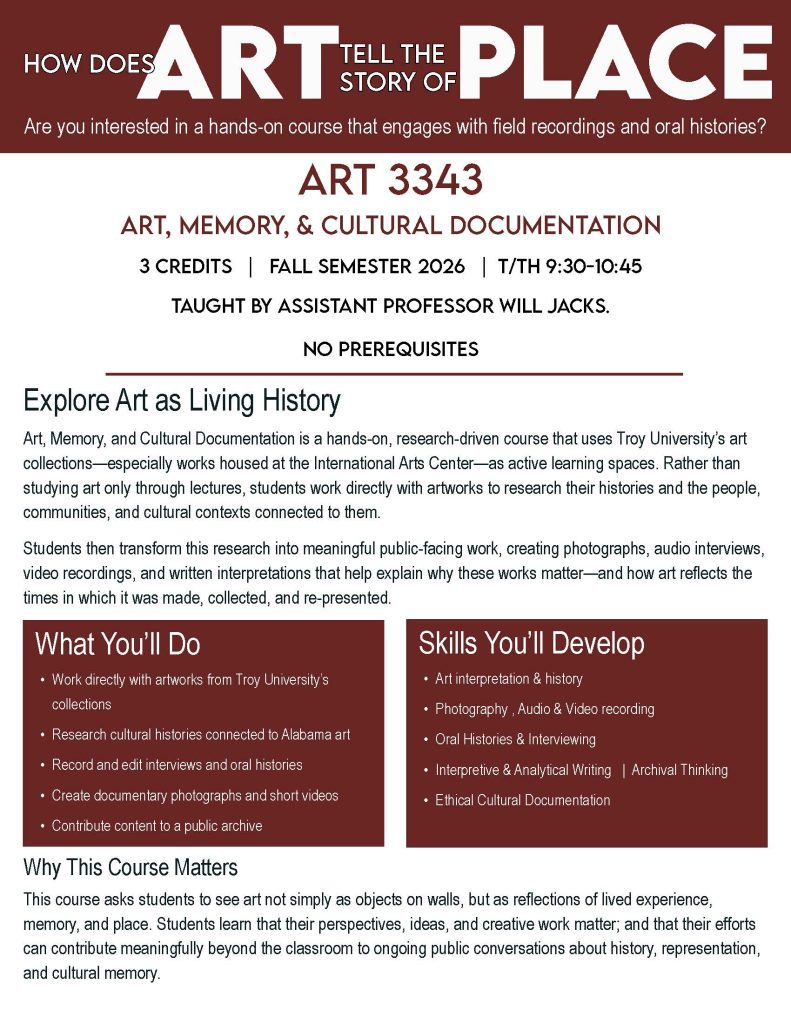
This fall a new hands-on, research-driven course will be offered in which students will work with Troy University’s art collections to research their histories, and the people, communities and cultural contexts connected to them.
Art, Memory and Cultural Documentation (ART 3343), will be taught by Mellon Fellow Will Jacks, an assistant professor in the Department of Art and Design, as part of the Mellon-funded initiative “(Re)reading Alabama’s Cultural Archives: Connecting Place to its Multitudes.”
“Rather than approaching artworks only through lectures, this experiential learning environment asks students work directly with the artwork, researching their histories and the people and communities around them,” Jacks said. “Then they will take that research and build contextual content around it through photographs, audio interviews, and video recordings with individuals and organizations that are somehow connected to and impacted by the art.”
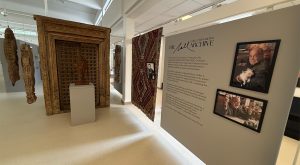
Dr. Priya Menon, the Mellon grant’s Project Lead, said the course is one of five being developed through the grant to deepen students’ understanding of the culture of Alabama. While the broader initiative spans multiple disciplines, ART 3343 focuses specifically on Alabama art through collections housed at TROY’s International Art Center.
“It addresses a clear gap by foregrounding local and regional archives that have remained underexamined, while situating them within broader scholarly conversations,” Menon said. “More broadly, the course advances the Mellon initiative’s mission by connecting place-based inquiry with interdisciplinary learning and bringing greater visibility to cultural narratives that have shaped Alabama’s artistic landscape. For students, this means not only studying art, but actively engaging in documenting, interpreting, and preserving cultural histories.”
Jacks hopes the course changes the way students think about art, culture and their role in preserving both.
“I hope students come away with applicable technical skills in photography, audio, video and writing; a deeper sense of responsibility as researchers, artists, culture keepers and makers; and a more nuanced and confident way of exploring art collections and exhibitions,” Jacks said. “Through interviews, photography, video, and interpretive writing, they will learn how creative and scholarly work can document cultural memory and contribute meaningfully to public archives and ongoing conversations about place, history, and representation.”
To learn more about the course or to join ART 3343, email Will Jacks at wjacks@troy.edu.
The largest grant in the history of the College of Arts and Humanities and delivered through the University Honors Global Scholars Program, the $449,000 Mellon Foundation grant supports deepening the understanding of Alabama’s cultural identity to foster social justice through research, curriculum development, and community engagement. The initiative will involve students and faculty along with local community in place-based inquiries.
About The Andrew W. Mellon Foundation
The Andrew W. Mellon Foundation is the nation’s largest supporter of the arts and humanities. Since 1969, the Foundation has been guided by its core belief that the humanities and arts are essential to human understanding. The Foundation believes that the arts and humanities are where we express our complex humanity, and that everyone deserves the beauty, transcendence, and freedom that can be found there. Through our grants, we seek to build just communities enriched by meaning and empowered by critical thinking, where ideas and imagination can thrive. Learn more at mellon.org.