On September 11, 2001, Dr. Duane Gunn was in The Pentagon, a short distance away from where American Airlines Flight 77 slammed into the building, igniting a huge fire that would burn until the following Saturday.
“I was in my third week at The Pentagon, and I was about 300 to 400 feet from impact,” Gunn said during a panel discussion held at Troy University on Thursday.
Gunn, a faculty member in the University’s Institute for Leadership Development, was joined on the panel by the Institute’s Executive Director Dr. Stephen Napoli, Sorrell College of Business Professor Stan Blankenship and Dr. Chanukah Anderson, TROY’s Director of Technology and Assessment who was a freshman at TROY on the day of the terrorist attacks.
“9/11 is one of those events that will be in the minds of people in the United States for many years to come,” Gunn said. “It was the first time that the United States was attacked on its own soil. You have to remember that on Dec. 7, 1941, when the attack on Pearl Harbor occurred, Hawaii was not yet a state. So, this was the first organized attack on United States soil by an outside organization.”
Dr. Napoli, who was an instructor pilot flying attack helicopters at Fort Hood, Texas at the time, said he was scheduled to conduct a training flight on the evening of Sept. 11, 2001, but after the tragic events of the morning with hijacked planes striking both towers of the World Trade Center, a third hitting the Pentagon and a fourth crashing in a field in Pennsylvania, he knew things would be different.
“Serving in the military was my calling at that point in life, so I was doing exactly what I was called to do,” Napoli said. “Sept. 10 was a normal day. When I went to bed on Sept. 10, we were a nation at peace. When I woke up on Sept. 11, we were a nation at war. I was scheduled to conduct a training flight as a part of the normal training process, but when the attacks happened, I knew I wouldn’t be flying that night. I didn’t know what we would be doing, but I knew things would be different.”
Blankenship was working in the apparel industry in 2001 and was in New York City as part of an acquisitions team.
“On Sept. 10, 2001, I was in New York City as a part of an acquisitions team. We were acquiring a company that was in New York,” Blankenship said. “We went out to eat that night at the base of the towers. We were directly across the street, and my boss, a native New Yorker told us we could go on a tour of the Twin Towers, and we said we would. As we were eating, it started pouring rain and we decided we would wait until the next day to do the tour. Obviously, we never had that opportunity.”
For the four panelists, the morning of Sept. 11, 2001, began as a “normal morning.”
For Gunn, the day was to involve a session of Pentagon orientation.
“I got up around 4:30 or 5 in the morning, got into the Pentagon between 7 and 7:30, and the primary thing I had going on that day was I was going through what they called Pentagon Orientation,” Gunn said. “It was a time to understand how to find your way around this crazy building. We had gone through a first session on getting to know the Pentagon and we reached a break. It was a little after 9 o’clock and an officer said, we need to turn on a tv, tower 1 has just been hit by a plane. As the tv is being turned on, we see the second jet hit tower 2.”
As an 18-year-old student living in Gardner Hall on the Troy Campus, Dr. Anderson started her day early, getting ready for class and watching the news. She recalled the big topic coming into the morning was whether basketball star Michael Jordan was coming out of retirement for a second time and whether or not he was going to play for the NBA’s Washington Wizards.
The leading news story was drastically different when she returned to the dorm after her 8 a.m. class.
“I went to class. It was a very short assignment, so when I was done, I went back to the dorm,” she recalled. “I looked at the tv, and Katie Couric was saying that there was breaking news, something was going on. The first plane had hit the tower and there was smoke billowing out. We stood and we watched, and the second plane hit. When the second plane hit, we could hear an audible gasp from our other dorm mates.”
From there, the students’ thoughts turned not to Katie Couric but another Katie, a dorm mate who was from New York City.
“The one thing I remember is that we had a Katie in the building. Katie was from New York. She was an athlete and was out at practice that morning,” she said. “We didn’t know if Katie knew what had happened in New York. Shortly thereafter, Katie walked in the building. We all stepped aside and she walked toward the tv. Someone said something had happened in New York. She just kind of freaked out in that moment. We immediately tried to reassure her. She tried to find ways to get in touch with her family. Our goal in that moment was trying to comfort our Katie.”
Katie would later reach her family and learn that they were ok, but the events of the day left students stunned and confused.
For Gunn, the moment quickly changed from trying to comprehend all that was happening to being evacuated from the building and trying to reach his wife to let her know he was ok.
“I had a cell phone because of the position I had,” Gunn recalled. “I made a phone call to try to call my wife and tell her I was ok, but my phone was dead. I couldn’t call my wife. My first thought was ‘whose phone number do I know.’ I called my older brother. I was able to get him and told him I was ok and to let my wife know.”
From there, the evacuees were loaded onto buses and taken across a primary interstate to Pentagon City.
“When we got on buses, there were good Samaritans everywhere in Washington D.C. that day. There were so many people who were just ready and willing to help us get home to our families that day,” he said.
Once it became apparent that the incidents of the morning were not accidents but rather an orchestrated attack, Blankenship and his colleagues turned their thoughts from their work and decided to climb the stairs to the rooftop of their building to try to get a glimpse of what was happening.
“One of the local guys said that we could climb to the rooftop and get a vantage point from there and we all agreed to do that,” Blankenship said. “We get to the roof, and I promise you we were not there 15 seconds when we saw the North Tower fall from the sky. Dust was everywhere. We were in shock and could not believe what we saw.”
Later that day, Blankenship and his coworkers were able to reach their families to let them know they were ok, but it was what he encountered as he left work that evening that will forever be etched in his memory.
“We had to walk back to our hotel, because there were no cars on the streets, no taxis. I remember passing a lot of people on the streets as we walked, and they were all almost like zombies with emotionless expressions on their faces. Everyone was in shock,” he recalled. “That was the quietest that I have ever heard it be in New York City.”
For Napoli, the drive to work that morning – a drive that normally took around 40 minutes – took two and a half hours that day.
“All military installations had shut down because there was no idea of the scope of the attacks at that point,” Napoli said. “I also didn’t know at that point that decisions were being made that never had to be made before such as shutting down the entire air space of the country. We live in a significantly large country with a significantly large amount of air travel, yet it was shut down.”
Napoli remembered the many “unknowns” at the time.
“That night, by the time I got home, we didn’t know if we were going to deploy immediately, didn’t know if we were going to deploy later, but I prayed about it,” he said. “On Sept. 12, I walked into my commander’s office and I told him, ‘You don’t have to ask, I’m ready to serve. If we are told to go someplace, put me on the list and I will go.’ I had such a peace about that. That was the sentiment of many people in uniform during that timeframe. I was proud to be a part of that through three tours in Afghanistan across a 32-year career. It was very rewarding to know that I contributed to the response that our nation called upon at that time.”
For the panelists, the unity and compassion shown in the aftermath of the attacks is something they will long remember. In the weeks following the attacks, Anderson remembers student organizations coming together in efforts to support those impacted by the 9/11 attacks.
“We came together as a dorm and extended compassion on that day,” she said. “And later organizations began to do what organizations do, coming together to help in any way that we could. I tell my children all the time, you don’t have to know people to be kind. We all deal with different things. When we extend and show compassion for others, it goes a long way. I think it speaks volumes about us and how we can help make this world better.”
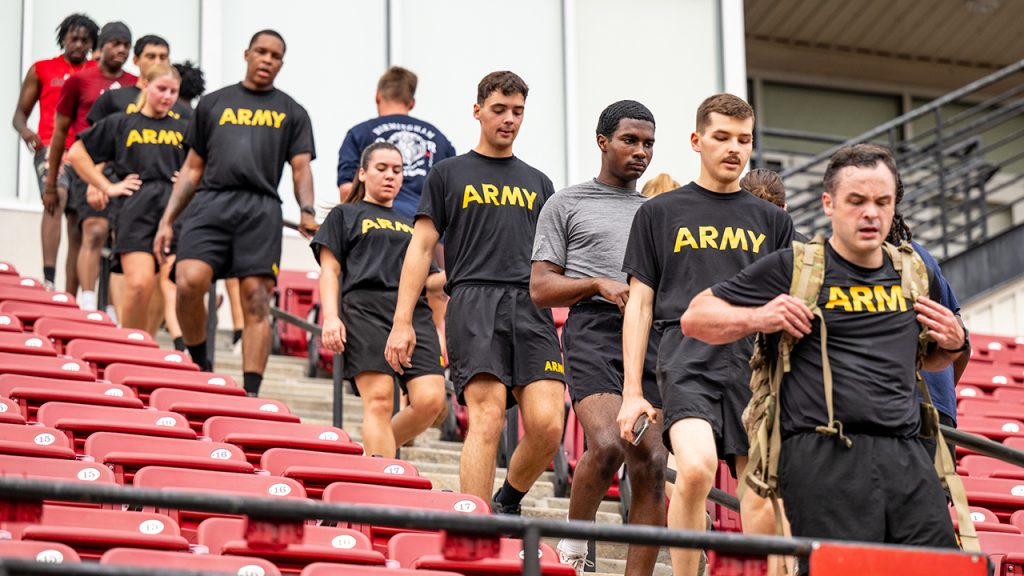
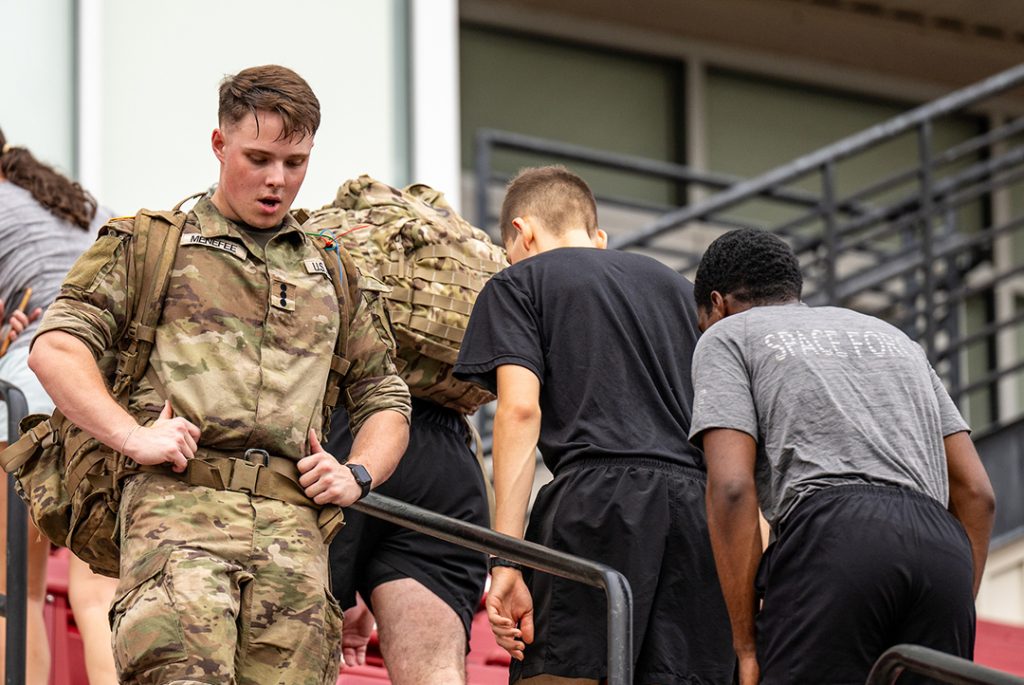
The panel discussion was one of the ways that Troy University remembered the tragic events of 9/11. Earlier in the day, Troy University Air Force ROTC held their annual stair climb at Veterans Memorial Stadium to honor the courage and sacrifice of America’s first responders.
The climb brought together students, faculty, staff, first responders and community supporters and approximated the number of stairs climbed by first responders in the World Trade Center towers on the morning of Sept. 11, 2001.