Students from Troy University put their technical knowledge, creativity and problem-solving skills to the test during the 2026 TROY Hackathon, a 24-hour competition that challenged teams to develop innovative solutions to real-world technology problems.
Hosted by the Department of Computer Science and others, this year’s event brought together nine teams of students who worked collaboratively to develop projects, overcome technical challenges and demonstrate their abilities in areas including cybersecurity and artificial intelligence.
Students had the option to develop an AI cybersecurity guardian, an AI study buddy or a higher-weighted project proposed by the Eagle Institute featuring the creation of an AI research assistant for public AU content.
The winning team of Hadiyel Nileshkumar, Jackson Rodriguez and Soeun Kim focused their project on identifying potential phishing threats through an artificial intelligence-powered Chrome extension.
Designed to evaluate websites and images for potential phishing risks, their program provided users with information to help assess the security of online content.
Nileshkumar, a graduate student in TROY’s cybersecurity program, took the lead on the project’s cybersecurity components.
“Because I’m a cybersecurity major, I had a stronger background in that area,” he said. “My development experience also helped me move quickly through the process and accomplish our goals within the 24-hour timeline.”
Rodriguez, a junior computer science major, helped develop the concept for the project, proposing a browser extension that could identify and block potentially harmful URLs.
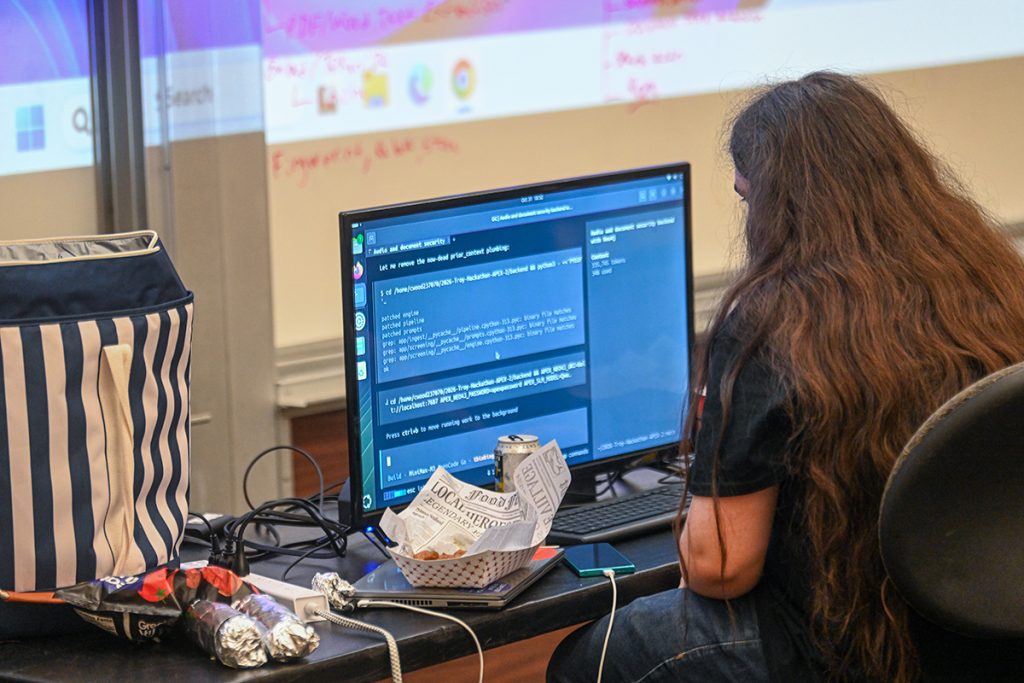
The team developed a web API using a Python server and integrated Google’s Gemini Flash API to analyze domain names and webpage HTML content. One of their biggest challenges was developing the AI prompts, Rodriguez said.
“That alone took approximately three to four hours because we had to repeatedly test and refine it to make sure the AI was identifying the right information,” he explained. “The system initially focused on subdomains rather than the actual domain name. We had to adjust the prompt to specifically instruct the AI to evaluate the main domain instead of its subdomains.”
That evaluation component was led by Kim, an exchange student from South Korea studying computer science, who focused on determining whether users could trust the scores generated by the extension.
Kim developed test datasets consisting of 65 websites and 30 emails and evaluated the system using precision, recall and F1 scores at different thresholds.
“I measured the system’s performance using precision, recall and F1 scores at different thresholds,” she said. “I compared our rule-based scoring system with the AI-generated reports. The results showed that the AI report reduced false alarms on our website test from 10 to zero. The email evaluation also successfully separated all 30 emails in our sample.”
Dr. Byungkwan Jung, associate professor in the Department of Computer Science, said he was impressed by the creativity and determination demonstrated by all nine teams.
“The students at this year’s TROYHack were extraordinary,” he said. “All nine teams confidently took on challenging projects and gave their best to turn ambitious ideas into working prototypes. As I visited them throughout the event, I was impressed by their thoughtful discussions, persistence and teamwork. I was especially proud to see them work through obstacles together, and I applaud the dedication they brought to TROYHack.”
Since his first involvement with TroyHack, Jung has seen the event develop beyond a traditional competition focused on solving problems and earning prizes to a chance for students to show off their skills and explore potential careers.
“I hope TROYHack grows into an annual statewide event where students from across Alabama can collaborate on exciting projects, learn from one another and discover where their interests and talents might lead,” he said.
The 2026 competition also welcomed a new industry sponsorship from MM Intelligence. Mishahal Palakuniyil, co-founder and chief technology officer, said the students’ creativity and willingness to develop functional solutions made a strong impression.
“In the industry today, it sometimes feels like people simply add AI to an existing product without necessarily thinking about the underlying system,” he said. “It was encouraging to see students who genuinely want to build systems that work and who care about making sure those systems are accurate and reliable.”
Gabriella Stewart, head of sales, said she is excited to see what future students can bring to the table.
“We look forward to having opportunities not only to mentor students, but also to bring the community together through local businesses in Montgomery, Troy and the surrounding areas,” she said. “We’re really excited about what we can build together.”
Additional sponsors for this year’s event include C Spire Foundation and the Eagle Institute.
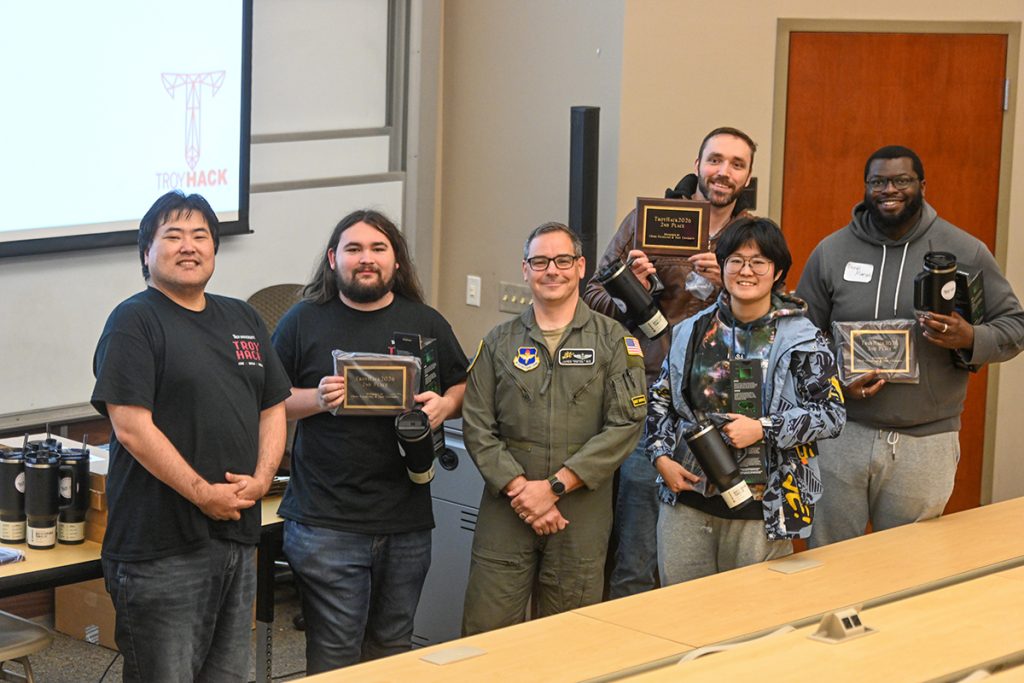
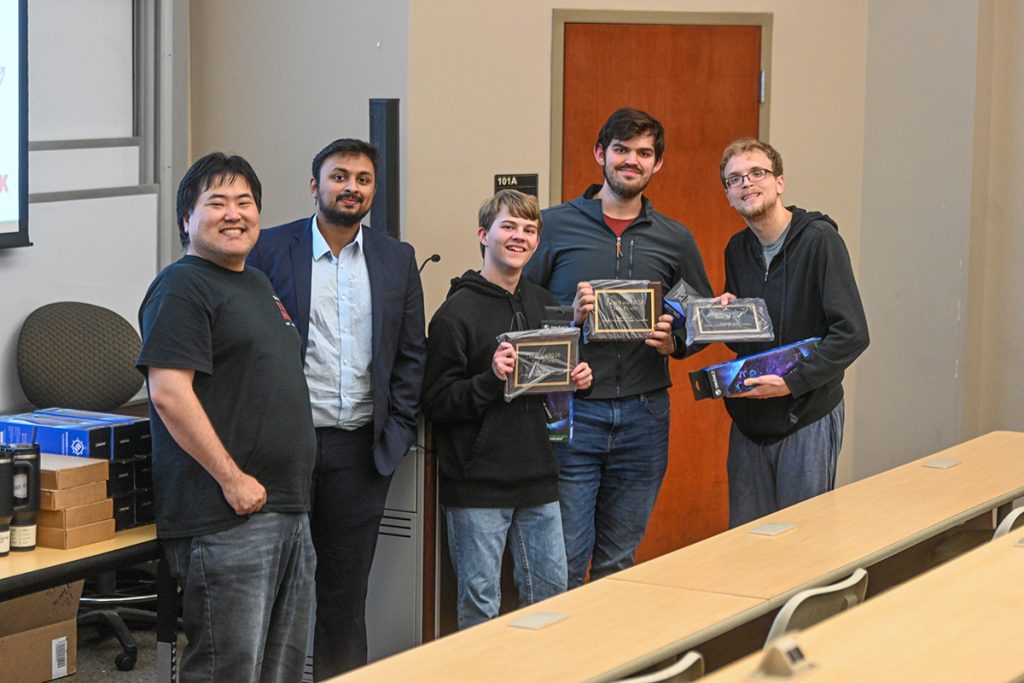
Second place winners were: Joey Hudson, Daniel Mensah, Xiameng “Chloe” Zhang and Charles Wood. Third place winners were: Cullen Lovvorn, Atticus Cornett and Ethan Burnham.
A gallery of images can be found here: https://troyuniversity.photoshelter.com/galleries/C0000oU40adM1Atg/G0000HTCxnNPhLM4/20261031-Hackathon