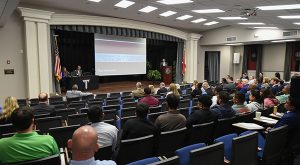
Troy University will host the second-annual Terry and Barbara Everett Symposium on Emerging Technologies on Sept. 18 at the Dothan Campus.
The symposium will bring together representatives from business, industry, the military, law enforcement and higher education to explore developments in artificial intelligence, cybersecurity and related technologies and their implications for organizations, the workforce and communities.

The day-long event is free to attend but registration is required and only a limited number of seats remain to attend.
Made possible by a grant from the late Wiregrass congressman and his wife, the Symposium focuses on how emerging technologies are transforming decision-making, automation, public communication, cybersecurity operations, and organizational workflows—while also addressing the ethical, legal, operational, and security risks that go with their adoption.
The symposium will include expert presentations and interactive roundtable discussions designed to foster cross-sector collaboration, policy dialogue, and practical guidance for organizations adopting these advanced technologies.
“AI agents now plan, reason, and take multi-step actions across enterprise systems, and governments are applying AI deeper into core operating functions. At the same time, binding regulation has arrived — the EU AI Act reaches its principal application date this year, U.S. states have enacted a fast-growing patchwork of AI laws, and federal preemption efforts are being contested in the courts,” said Dr. Edward Fulford, director of the Center for Applied Innovation and Cybersecurity at TROY.
“This symposium explores how organizations can responsibly deploy AI systems while maintaining transparency, accountability, data privacy, regulatory compliance, and public trust,” he said.
In addition to Fulford, who is assistant professor of cybersecurity and business analytics in the Sorrell College of Business and holds a Doctor of Business Administration degree from the University of South Florida, other leading industry and government AI experts are presenting during the day.
Eddie Sorrells, CEO of Dothan-based DSI Security, will present “The 2026 AI Regulatory and Legal Landscape: Building Public Trust.
Dr. Jay Claiborne, professor of practice in Information Systems at TROY, will present “From Red Flag to Real Consequence: How Much Should AI Influence Decisions?”
Anna Grace Du Noyer, Global Chief AI, Ethics and Impact Officer at Electus Global Education, will present “Raising AI: The Formative Years,” and Klint Walker, Cybersecurity Advisor at the Cybersecurity and Infrastructure Security Agency, U.S. Dept. of Homeland Security, will present “Algorithmic Homeland: How AI is Reshaping Cybersecurity and Homeland Defense.”
Fulford will present “The AI Ethics are in the Output: A Cybersecurity, Governance, and Digital Innovation Perspective for Government & Business Leaders.”
Alabama’s Chief AI Officer Aaron Wright will present “Human judgment as Critical Infrastructure: Thinking in an AI-Assisted World.”
The symposium will wrap with a panel discussion on “Maturing AI Ethically and Responsibly: Governance, Trust, and Growing Pains.”
The symposium is named for former newspaper editor and publisher, Terry Everett, who retired from Congress in 2009, served as an intelligence analyst from 1955 – 1959 in the U.S. Air Force’s 6901st Special Communication Group. Later, he served on the Armed Services Committee and served on the Permanent Select Committee on Intelligence, where he was the first chair and ranking member of the Subcommittee on Oversight and Investigations.
It was from this base, Everett wanted to do something that directly would benefit the people of southeast Alabama by educating them to the dangers posed by computer and internet sources.
“My husband was always – from the beginning – a techie nerd,” said Barbara Everett. “He had all the technology . . . from the beginning when we started our newspaper. He ordered the first computer in about a 100-mile radius of Dothan.”
Technology was passion for the journalist-turned-statesman, she said.
“He got to know a lot about national security. He got to know a lot about all the top-secret things that were going on and about how tech can be invaded and how it can be destructive in our society,” Everett said. “He was just passionate about developing something to make businesses and (government) agencies aware of the kinds of problems that he knew.”