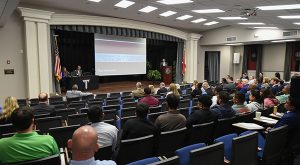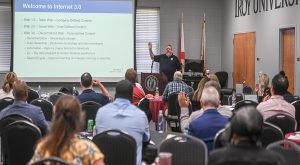
The Terry and Barbara Everett Symposium on Emerging Technologies held at the Troy University Dothan Campus in September brought together representatives from the business industry, the military, law enforcement and higher education to explore developments in artificial intelligence, cybersecurity and related technologies and their implications for organizations, the workforce and communities.
Made possible by a grant from the late Wiregrass congressman Terry Everett and his wife, Barbara, the symposium focuses on how emerging technologies are transforming decision-making, automation, public communication, cybersecurity operations and organizational workflows while also addressing the ethical, legal, operational and security risks that go with their adoption.
Terry retired from Congress in 2009 and served as an intelligence analyst from 1955 – 1959 in the U.S. Air Force’s 6901st Special Communication Group. Later, he served on the Armed Services Committee and served on the Permanent Select Committee on Intelligence where he was the first chair and ranking member of the Subcommittee on Oversight and Investigations.
“This symposium is very important to me because I know he would have been very pleased with this,” Barabra said. “He retired nearly 20 years ago, and someone mentioned that he couldn’t talk about what he knew from those committees. But he knew this was going to happen, and he was passionate about trying to provide some kind of preparation for our community.”
Organized by Dr. Ed Fulford, director of the Center for Applied Innovation and Cybersecurity at TROY, this year’s event focused on the ethical use of agentic and generative AI.
“We intentionally made this symposium content-rich because we wanted to bring together a group of people who could address a range of subjects,” Fulford said. “Everything focused on the ethical use and expansion of generative artificial intelligence in business, the public sector, education and everyday life. We explored how these technologies are changing the world around us and how life may continue to change as a result.”
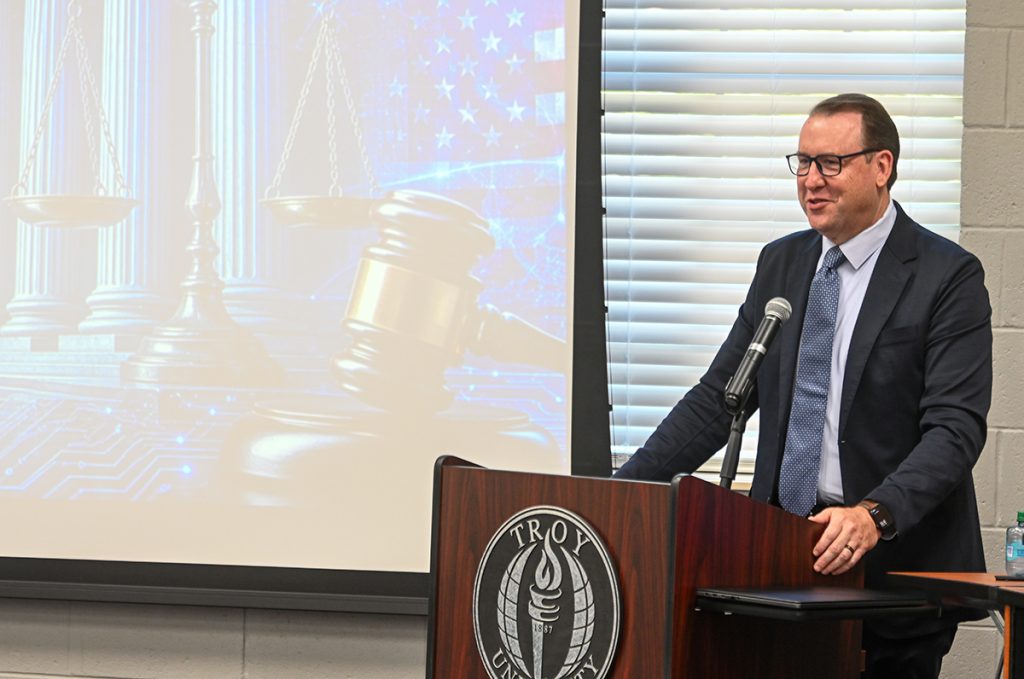
Speakers and topics included Eddie Sorrells, “The 2026 AI Regulatory and Legal Landscape: Building Public Trust;” Dr. Jay Claiborne, “From Red Flag to Real Consequence: How Much Should AI Influence Decisions;” Anna Grace Du Noyer, “Raising AI: The Formative Years;” Klint Walker, “Algorithmic Homeland: How AI is Reshaping Cybersecurity and Homeland Defense;” Dr. Edward Fulford, “The AI Ethics are in the Output: A Cybersecurity, Governance, and Digital Innovation Perspective for Government & Business Leaders;” and Aaron Wright, “Human Judgment as Critical Infrastructure: Preserving Critical Thinking in an AI-Assisted World.”
Sorrells, a TROY alum and CEO of DSI Security Services, said one of the most engaging aspects was discussing AI with his peers, but also the TROY students in attendance.
“Some of the challenges students are grappling with today are different from those I faced, but thankfully, Troy University is creating opportunities through events like this symposium to explore those challenges,” he said. “It was valuable to hear from other leaders in the field and consider how I can take those insights back to my company. It also helped me think about how to address the legal and regulatory challenges we’re seeing.
“It’s up to us, as individuals and businesses, to establish those safeguards in real time rather than relying solely on government agencies or regulators,” he added. “We have to build our own ethical standards into what we do, make sure we’re doing things the right way and not wait for someone else to address these issues down the road. Overall, it was a great event and another step toward figuring out the AI conundrum.”
Adam Claar, AI technical lead in the State of Alabama’s Office of Information Technology, said he was very encouraged by the sessions and involvement of the TROY students.
“The sessions were very well-informed and went much deeper than I expected. It was really good and very informative,” he said. “Three or four students from one of the computer science clubs approached me, and they’re going to reach out about possibly doing some things together, talking with students and sharing my life experience. I worked in the private sector for 30 years before switching to state government, so I’m hoping I can help out.”
This symposium was the second event sponsored by the grant from the Everetts.
“The participation in both seminars has been very good. The feedback I have heard after the first seminar and this one has been encouraging,” Barbara said. “We need to learn how to manage these technologies and build integrity into how we use them. I understand that aspects of these technologies have been around for many years, but as we begin to use them more extensively, we have to build integrity into the process.”
For more information on Troy University’s cybersecurity and AI-related undergraduate and graduate programs, visit the Department of Computer Science website.