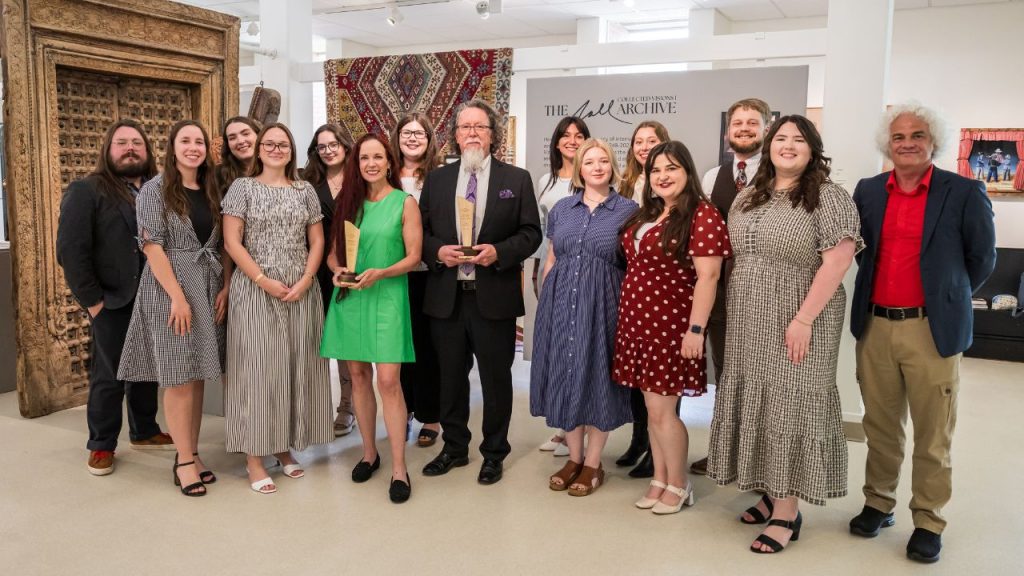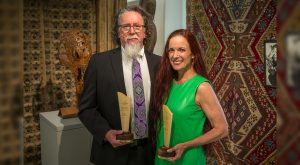
Award-winning novelist, Tom Franklin, and Beth Ann Fennelly, Poet Laureate of Mississippi from 2016-2021, received Troy University’s Hall-Waters Prize on Friday, April 17 at the Troy Campus.
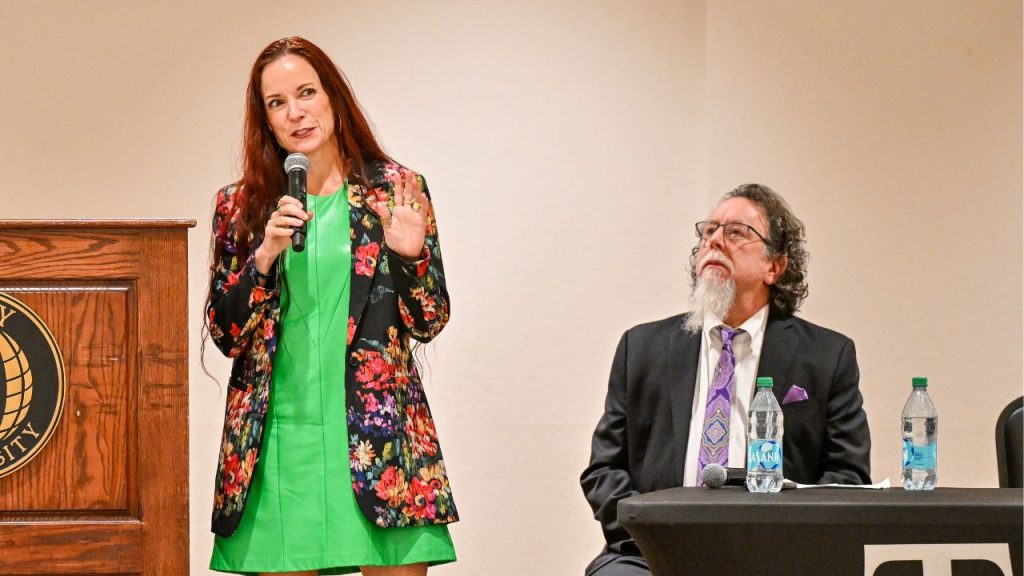
The day began with Franklin and Fennelly meeting with Dr. Kirk Curnutt’s English senior seminar class for a discussion in the Lamar P. Higgins Ballrooms and responding to questions from TROY students. The award was presented during a luncheon at the International Arts Center.
Endowed by the late Dr. Wade Hall, a Bullock County native and TROY alumnus, in memory of his parents Wade Hall, Sr. and Sarah Elizabeth Waters, the award is presented regularly to a person who has made significant contributions to Southern heritage and culture in history, literature or the arts. Dr. Wade Hall was an author, former member of the faculty at the University of Florida and professor emeritus of English at Bellarmine University in Louisville, KY.
Troy University Chancellor Dr. Jack Hawkins, Jr. credited Hall and the lasting impact of his legacy.
“Wade came to TROY from rural Bullock County, and I remember the day that he told me that it opened his world,” he said. “It was a whole new environment for him, and he loved TROY because it was truly a brave new world that was made available to him. He took full advantage of it. He loved learning and he loved people, and his works reflected that. He graduated from TROY in 1953 and then he served at Bellarmine University in Louisville from 1969 until 1999. When he retired, he came back to Alabama, and it was then that he was reconnected to his alma mater. He very generously made a difference, and we appreciate that so much.”
Gregg Swem, who represented the late Dr. Hall, discovered several parallels between the winners of this year’s Hall-Waters Prize honorees and the man who founded the award.
“Like Tom Franklin, Wade came from a rural Alabama background, the Inverness community, Inverness community of nearby Bullock County,” Swem said. “Tom was reared in the country crossroads of Dickinson in Clarke County on the other side of the state, although there’s almost 30 years difference in their ages, there are definite similarities. When I came across a passage in Beth Ann’s micro memoirs describing a reading tour that Tom did in southern Germany, which included the University of Heidelberg, I stopped in my tracks. In the mid 1950s, Wade served in the U.S. Army Medical Corps division in Heidelberg, where he taught himself German and French by reading American novels in those languages. His German experience was one he always treasured.”
Though their bodies of work differed, Swem noted that Hall and Fennelly shared a devotion to poetry.

“He wrote poetry, but he was probably best known as editor of Kentucky Poetry Review, a long running literary journal that featured poets of national and international stature, as well as many fine and earnest but less familiar poets. Beth Ann is former Poet Laureate of Mississippi; her poetry strikes me as hard hitting and full of verb. While Wade was never Poet Laureate of Kentucky. He was usually instrumental in the selection process for candidates of this post while he lived in the Bluegrass State.”
Fennelly and Franklin, both professors at the University of Mississippi’s Department of English, are the first co-authors to receive the Hall-Waters Prize. When asked about writing together, Franklin said the collaboration had its challenges, but that the two found the process rewarding.
“We learned about each other,” he said. “We really thought it would take us a year or two, it did not. We had low moments, as any writer does in a book, but we could share these low moments and that made it better.”
Fennelly, who has called Mississippi home for more than two decades, spoke passionately about the South’s literary legacy and how she draws inspiration from the region.
“Southern literature has been outpunching its weight the whole time, and what southern literature has contributed to the national output has completely outsized what it was supposed to do,” she said. “I’ve chosen the South, but it’s chosen me back in some ways that feel really gratifying and beautiful. So, I do get a lot of inspiration from Southern literature, and I think it’s shaped my ear.”
In addition to her work as a writer, Fennelly has dedicated herself to bringing literature to students across Mississippi, an effort she says has shaped her just as much as it has her students.
“I have always loved teaching, I find it really fulfilling,” she said. “So, I never wake up in the middle of night and think, ‘What am I doing with my life?’ I have seen the difference that, you know, teaching and literature can make for students. I’ve seen literature improve students’ lives. I’ve seen reading help students figure out who they are and what their purpose is.”
As one of the leading voices in “grit lit,” a genre exploring the roughest parts of Southern culture, Franklin was asked whether he has had to fight against publisher stereotypes of the South. He said he has not seen it that way.
“I’ve always loved being a Southern writer. It’s like being a left-handed pitcher, in a way. It comes with a built-in audience. There are a lot of great Southern conferences and anthologies, so I think it’s a real advantage to be a Southern writer.”
Franklin is the author of several previous novels, including Hell at the Breech, Smonk, and Crooked Letter, Crooked Letter, as well as his Edgar Award-winning short story collection Poachers. Fennelly works in a variety of genres to include her poetry collection Tender Hooks, her micro-memoir collection Heat & Cooling, and her current book in the same genre, The Irish Goodbye, published on Feb. 24. Together in 2013, they produced a historical novel set in 1920s Mississippi during the Prohibition era and the Great Mississippi Flood. The novel follows the story of a bootlegger who comes upon an abandoned baby, leading to a tale of suspense and murder.
A photo gallery from the Hall-Waters events is available here.