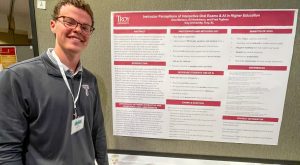
At the Southeastern Psychological Association Conference in New Orleans, Eli Hankinson, student of Troy University’s College of Education and Behavioral Sciences, presented research examining interactive assessments as an innovative approach to student learning in the age of artificial intelligence.
Hankinson’s research focused on interactive oral assessments (IOAs), a method that emphasizes real-time, unscripted conversations between instructors and students as a way to evaluate understanding. As AI tools become more prevalent in academic settings, the study explored how IOAs can provide a more authentic measure of student knowledge while encouraging meaningful engagement with course material.
Unlike traditional testing formats, IOAs allow students to demonstrate their comprehension through dialogue, requiring them to think critically and respond in the moment. This approach not only supports deeper learning but also helps develop communication and problem-solving skills that translate to professional environments. The format may also reduce the likelihood of artificial intelligence use during assessments due to its conversational and individualized nature.
In addition to examining the benefits of IOAs, the research is expanding to include surveys that assess both student and faculty perceptions of this assessment style at Troy University. The next phase will explore familiarity with IOAs, prior experiences, and the potential for implementation across a variety of courses, including both online and in-person formats.
“I originally was working on a different research project but switched to this topic because of my passion for education and my desire to help students in our ever-evolving culture,” said by Eli Hankinson. “I am incredibly grateful for the many opportunities that Troy has provided in several different areas of my life and for the people who have given me a chance to grow. Go Trojans!”
The opportunity to conduct and present this research was supported by faculty within Troy University’s College of Education and Behavioral Sciences, including mentorship from Dr. Gina Mariano, Dr. Fred Figliano and Dr. Heidi Beattie, as well as additional support from the psychology department. His experience highlights Troy University’s commitment to undergraduate research and its emphasis on preparing students to engage with real-world challenges in their fields.