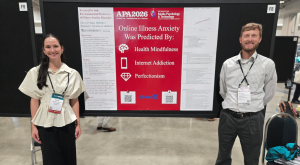
Olivia Polina Mills, a Troy University psychology student, presented research examining why some people experience intense anxiety about having or developing a serious illness after consuming health information online.
Working with Dr. Nettelhorst, Mills focused on cyberchondria which is illness anxiety intensified by internet use. The everyday example is easy to picture: scrolling Facebook Reels, seeing a video titled “Five signs you may have cardiac disease,” and then searching the symptoms online as worry grows.
The study tested whether five factors (helicopter parenting, socially prescribed perfectionism, internet addiction, health consciousness, and scores on a patient health questionnaire) could predict greater illness anxiety.
“Our thesis was that illness anxiety, particularly when expressed through cyberchondria, is associated with a combination of personality traits, health-related beliefs, and patterns of internet use,” Mills said. Of the five factors, health consciousness, internet addiction, and socially prescribed perfectionism significantly predicted greater illness anxiety. The five predictors collectively supported the hypothesis.
Mills originally hoped to recruit TROY students, but found participation difficult without payment. She adapted by using Prolific and Qualtrics, securing a sample of 157 adults in the United States who were at least 18 and whose primary language was English (roughly 70 women and 85 men).
The project began when Mills needed research experience for a competitive Doctor of Psychology application. She messaged several professors after seeing a research poster. Dr. Nettelhorst’s work at the intersection of technology and psychology stood out because of her longstanding interest in how screen time affects mental health.
“I had never done research before,” Mills said. “I did a chemistry lab and it was very confusing. This I love doing.” She described Dr. Nettelhorst as making the process fun and accessible while also supporting her beyond the study itself, including with graduate school applications.
Mills presented first at TROY’s conference, where she was nervous as a first-time presenter. She later presented at the American Psychological Association meeting in Washington, D.C. She arrived a little turned around by the size of the conference but grew confident once she was with her poster.
“Once I got in there seeing all the people, it just made me feel like I was supposed to be there,” she said. “I was really confident in what we had. It was very fun presenting to everybody. We had a bunch of people come by and look at our poster and just being able to share what we’ve been working on this past year and a half. It was so nice. It made it all feel worth it.”
What surprised her most was the scale of the research community. “I feel like it’s not really talked about that much, at least from my experience being at TROY,” she said. “So when we started doing it… I realized so many people are into this… and it makes you feel like you’re doing the right thing.”
Her advice for other students is straightforward: reach out to professors. “Professors, I didn’t realize, but they actually want to help you,” she said. “When I started working with Dr. Nettelhorst, he was so willing and he really went the extra mile… I definitely recommend doing research, do it, get yourself a mentor. I would do it again if I had the choice.”
The work reflects the determination and confidence that come from pursuing a question that matters, adapting through practical challenges, and standing behind the results with the support of a mentor.